






What's Happening?
UK AI Minister Kanishka Narayan has voiced the government's determination to foster domestic technology development, particularly in the artificial intelligence sector. This statement comes as Fractile, a UK-backed AI chip startup, achieved a $7 billion
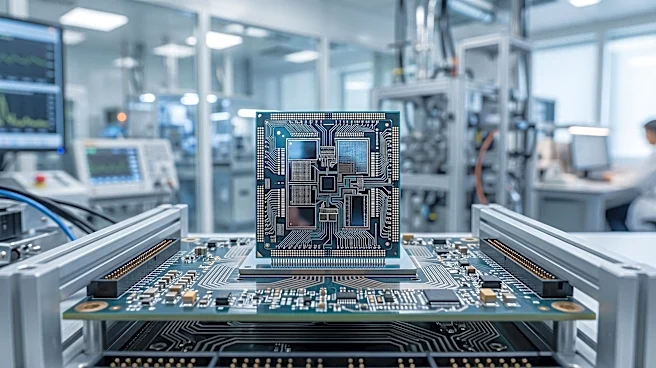
valuation after securing $720 million in a Series C funding round. The funding included investment from Britain's Sovereign AI fund and the British Business Bank. Fractile, based in London and Bristol, is focused on developing AI inference chips designed to enhance performance and reduce energy consumption and costs. The company plans to release its first commercial chip next year. Minister Narayan highlighted a historical trend where the UK has produced leading scientific ideas but seen the resulting technology and wealth generated elsewhere, a pattern the government aims to reverse. While the UK is home to chip designer Arm, its semiconductor manufacturing industry remains relatively small compared to the US and Asia.
Why It's Important?
The UK government's focus on retaining and developing AI technology domestically, as articulated by AI Minister Kanishka Narayan, is crucial for national economic growth and technological sovereignty. By supporting companies like Fractile, the UK aims to build its own AI infrastructure, reducing reliance on overseas computing power and manufacturing. This initiative could create high-value jobs, stimulate innovation, and establish the UK as a significant player in the global AI hardware market, currently dominated by a few key players like Nvidia and Asian manufacturers. For the U.S., this development signifies increased competition and potential collaboration opportunities in the AI sector. A stronger UK AI industry could lead to more diverse supply chains and advanced technological partnerships, but also intensifies the global race for AI dominance, impacting U.S. companies and strategic interests in the long term.
What's Next?
Fractile is set to release its first commercial chip next year, which will be a critical test of its technology's market viability and its ability to deliver on promises of faster performance and reduced costs. The UK government is expected to continue its strategic investments and policy support to nurture domestic AI companies and infrastructure. This could involve further funding initiatives, regulatory frameworks designed to encourage innovation, and efforts to attract and retain top AI talent. The success of companies like Fractile will likely influence future government spending and policy decisions in the AI sector. Internationally, other nations, including the U.S., will be closely observing the UK's progress in building its AI capabilities, potentially leading to shifts in global investment patterns and strategic alliances in the technology landscape.
Beyond the Headlines
The UK's ambition to reverse the trend of scientific ideas leading to wealth creation elsewhere touches upon a broader challenge faced by many nations: how to translate research excellence into economic leadership. This effort is not just about financial investment but also about fostering an ecosystem that supports innovation, manufacturing, and market penetration. The emphasis on 'industrial AI made in Europe' by European Commission President Ursula von der Leyen, as mentioned in related discussions, underscores a growing desire for technological self-sufficiency and control over critical digital infrastructure. This push for domestic AI infrastructure raises questions about global technological interdependence, data sovereignty, and the potential for new trade barriers or collaborations in the high-tech sector. The ethical implications of AI development and deployment, including job displacement and data privacy, will also remain central to these national strategies.