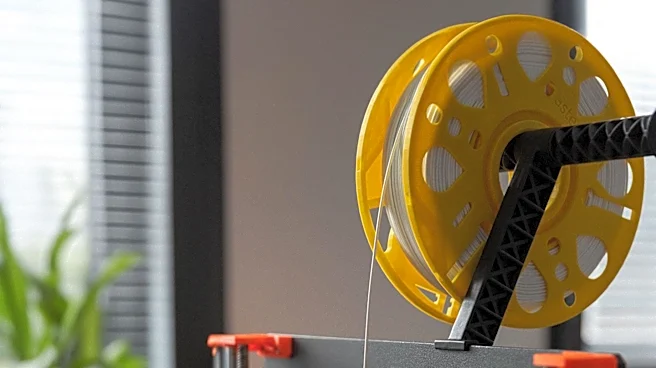










What's Happening?
The desktop 3D printing market, valued at US$7.90 billion in 2026, is forecast to grow to US$23.00 billion by 2035, exhibiting a Compound Annual Growth Rate (CAGR) of 12.60%. This growth is attributed to significant improvements in print speed, reliability,
and ease of use, which have broadened the user base beyond hobbyists to include schools, engineers, designers, and dental labs. Key market trends include the standardization of fast, enclosed FDM printers, the spread of multi-color and multi-material printing, and the emergence of compact SLS systems for professional desktops. North America led the market in 2025 with a 33.80% share, valued at US$2.37 billion, while Asia Pacific is projected to be the fastest-growing region. Leading companies like Bambu Lab, Creality, and Formlabs are strengthening their presence across various segments.
Why It's Important?
The rapid expansion of the desktop 3D printing market has significant implications for U.S. industries, particularly in manufacturing, education, and healthcare. The increased accessibility and affordability of these printers empower small businesses, startups, and individual innovators to rapidly prototype and produce specialized parts, fostering innovation and reducing reliance on traditional manufacturing supply chains. For the U.S. education sector, desktop 3D printers provide hands-on learning tools for STEM fields, preparing a skilled workforce for future technological demands. In healthcare, particularly dental labs, the adoption of resin printing for models, guides, and aligners streamlines processes and improves patient care. North America's leading market share indicates strong domestic demand and a robust ecosystem for both professional and consumer adoption, contributing to economic growth and technological advancement.
What's Next?
The desktop 3D printing market is expected to continue its growth trajectory, with further advancements in multi-material printing, compact SLS technology, and integrated software ecosystems. The increasing adoption in professional fields like engineering and healthcare, alongside sustained consumer interest, will drive demand for more sophisticated and user-friendly printers. Companies will likely focus on expanding material ranges, improving accuracy, and enhancing workflow integration to cater to diverse professional needs. The market will also see continued price competition, particularly in the consumer segment, and potential impacts from tariffs on printers manufactured in China. The growth of model libraries and cloud-based printing solutions will further enhance accessibility and ease of use, solidifying the technology's role in various sectors.
Beyond the Headlines
The growth of desktop 3D printing represents a democratization of manufacturing, shifting production capabilities from large industrial facilities to smaller workshops and even homes. This decentralization has profound implications for supply chain resilience, allowing for localized production and reducing dependence on global logistics. Ethically, it raises questions about intellectual property rights for digital designs and the potential for unregulated manufacturing of certain items. Culturally, it fosters a 'maker' movement, encouraging creativity and problem-solving skills. The increasing use of 3D printing in education is not just about teaching technology but also about cultivating a new generation of innovators who can translate digital designs into physical realities, fundamentally changing how products are conceived, developed, and consumed in the U.S. and globally.