



What's Happening?
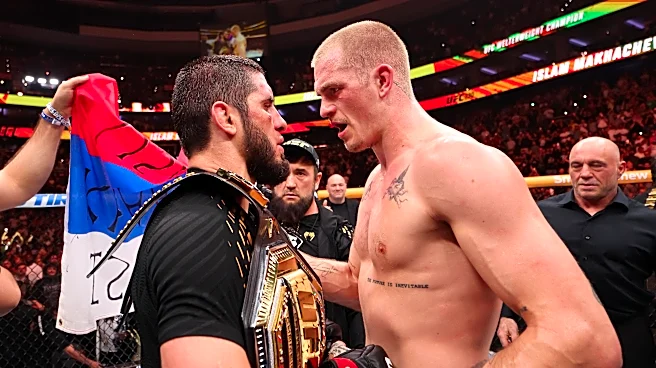
UFC champions Islam Makhachev and Jon Jones are currently involved in a public dispute on social media regarding their respective legacies and the 'Greatest of All Time' (GOAT) title in mixed martial arts. The debate was ignited when Makhachev questioned
the validity of Jones's winning streak, citing Jones's past doping violations. Makhachev stated that while he acknowledges Jones as one of the greatest athletes, his achievements are diminished by having been 'caught doping twice,' suggesting that a new count for his streak should have started after these incidents. Jones, in response, defended himself by stating that the United States Anti-Doping Agency (USADA) had clarified that the picogram found in his system was 'not found to be PERFORMANCE ENHANCING or INTENTIONAL.' He also highlighted his consistent victories in the octagon and challenged Makhachev to reach his level of success. Makhachev countered, asserting that Jones's career seems 'tied to breaking the rules one way or another' without facing blame. This exchange has brought their impressive, yet complicated, career records into sharp focus.
Why It's Important?
This public debate between two of the UFC's most prominent figures is significant for several reasons. Firstly, it directly impacts the narrative surrounding the 'GOAT' discussion in MMA, a topic that consistently generates fan engagement and media attention. The accusations and defenses exchanged by Makhachev and Jones could influence public perception of their careers and legacies. Secondly, Makhachev's comments about doping bring renewed scrutiny to the issue of performance-enhancing drugs in sports, particularly within the UFC. This could prompt further discussions about drug testing protocols, past penalties, and how such incidents affect a fighter's standing in the sport's history. For the UFC, this high-profile disagreement, while potentially controversial, also serves to generate buzz and maintain interest in its athletes and the sport itself. It highlights the intense competitive spirit and the high stakes involved in achieving and maintaining top-tier status, both inside and outside the octagon. The debate also underscores the evolving nature of how athletes' legacies are judged, with factors beyond in-ring performance, such as adherence to rules and ethical conduct, playing an increasingly important role.
What's Next?
The immediate future will likely see continued engagement from fans and media on this topic, with further analysis of both fighters' careers and the implications of their social media exchange. Other fighters, analysts, and commentators may weigh in, further fueling the debate. While there is no indication of a direct fight between Makhachev and Jones, their ongoing verbal sparring could create a compelling storyline within the UFC. This could potentially lead to increased interest in their individual upcoming fights and career trajectories. The UFC may also need to consider how to manage such high-profile disputes between its champions, especially when they involve sensitive topics like doping allegations. This situation could also prompt a re-evaluation of how the UFC and its partners, like USADA, communicate about past doping incidents and their long-term impact on fighter legacies. Ultimately, the debate is expected to continue shaping the public discourse around MMA greatness and the criteria used to define it.
Beyond the Headlines
Beyond the immediate back-and-forth, this debate touches upon deeper ethical and philosophical questions within professional sports. It highlights the tension between raw athletic achievement and the integrity of competition. The discussion around Jones's past doping incidents, despite USADA's clarifications, underscores the lasting stain that such allegations can leave on an athlete's reputation and how difficult it is to fully rehabilitate public trust. This raises questions about forgiveness, redemption, and the criteria for judging an athlete's entire career. Furthermore, the social media platform as the arena for this debate reflects the modern landscape of athlete communication, where direct engagement with fans and rivals can quickly escalate into significant public discourse. This shift from traditional press conferences to direct online exchanges has profound implications for how sports narratives are shaped and controlled, offering both unprecedented transparency and potential for unmoderated conflict. The ongoing 'GOAT' debate, fueled by these exchanges, will continue to evolve as new generations of fighters emerge and challenge existing paradigms of greatness.