







What's Happening?
PicoJool, a Palo Alto-based company, has successfully raised $27.5 million in Series A funding, led by Socratic Partners, with additional participation from Hudson River Trading. This new capital brings PicoJool's total funding to $39.5 million, following
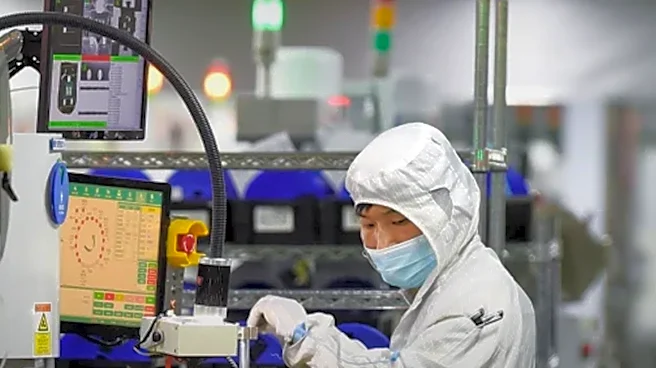
a $12 million seed investment. The funding is earmarked to commercialize and scale its optical connectivity technology, which is designed to address the growing data movement challenges within increasingly dense AI data centers. PicoJool's core technology focuses on vertical-cavity surface-emitting lasers (VCSELs), including high-speed 100G and 200G VCSEL products and lower-power MicroVCSEL configurations. The company plans to use the funds to expand its teams and facilities in the United States and Taiwan, advance its laser products through customer qualification, and build the necessary manufacturing and support capacity for hyperscalers and data center operators.
Why It's Important?
This significant Series A funding for PicoJool highlights the critical need for advanced optical connectivity solutions in the rapidly expanding U.S. AI infrastructure. As AI models grow in complexity, the ability to move data quickly and efficiently between thousands of processors has become a major bottleneck. Inefficient data movement leads to processors spending more time waiting than computing, thereby reducing the productivity of expensive AI hardware. PicoJool's VCSEL technology aims to improve this by offering high-bandwidth, energy-efficient optical links, which are crucial for managing power density, cooling requirements, and the overall cost-effectiveness of AI data centers. The investment underscores a broader industry recognition that optical interconnects are essential for the continued scaling of AI, directly impacting the performance and economic viability of AI-driven applications and services across various U.S. industries.
What's Next?
PicoJool's immediate focus following this funding round will be on transitioning its high-speed VCSEL technology from early sampling to full customer qualification and volume production. The company plans to expand its operational capabilities in the U.S. and Taiwan, including growing its teams and facilities, to meet the demands of hyperscalers and data center operators. A key step will be working with manufacturing partners, such as WIN Semiconductor, to ensure repeatable output and meet stringent reliability requirements. PicoJool will also continue to develop its product portfolio, including quad-100G, quad-200G, and 32-by-50G NRZ MicroVCSEL configurations, to support 1.6-terabit and eventually 3.2-terabit connectivity. The success of these efforts will determine whether PicoJool's VCSEL approach becomes a significant component of future AI data center architectures.
Beyond the Headlines
The investment in PicoJool reflects a deeper strategic shift in the AI hardware ecosystem, where the focus is moving beyond raw processor performance to the efficiency of data movement and interconnects. The 'competitive race to move data more efficiently' involves not just laser suppliers but also silicon photonics companies, networking vendors, and accelerator manufacturers, indicating a complex and evolving market. The involvement of strategic investors like Hudson River Trading, which operates large-scale computing systems, signals a direct industry need for these solutions. This trend suggests that future innovations in AI will increasingly depend on breakthroughs in optical technology and integrated system design, rather than solely on improvements in chip processing power. The long-term implications include a potential restructuring of the semiconductor supply chain, with greater emphasis on specialized optical components and advanced packaging solutions to support the next generation of AI computing.