








What's Happening?
Northrop Grumman has been awarded a $7 million contract under Phase 2 of DARPA’s Technologies for Heat Removal in Electronics at the Device Scale (THREADS) program. This contract focuses on developing diamond-cooled microchips designed to enhance power,
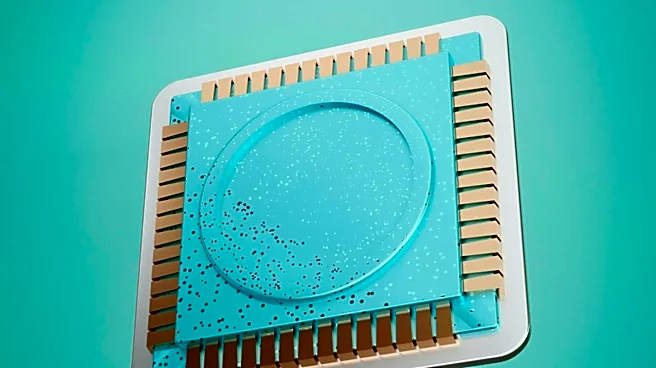
speed, and performance for military radar and communications systems. The company's approach involves embedding a layer of diamond on the backside of devices within microscopic channels, a technique developed in partnership with Stanford University. This innovation allows for efficient heat transfer away from hotspots, enabling the chips to operate effectively even at maximum power. Northrop Grumman aims to make these diamond-enhanced chips over three times more powerful, which will significantly boost the capabilities of RF transmitters for military applications and next-generation satellite links. This development builds on Northrop Grumman's research and investment in diamond technology, which began in 2019, leveraging diamond's superior heat-conductivity and extreme temperature endurance.
Why It's Important?
This advancement in microchip technology is crucial for strengthening the American supply chain in defense and commercial systems. By designing, manufacturing, and packaging millions of microelectronics annually within the United States, Northrop Grumman ensures the sustainability and protection of the nation's manufacturing infrastructure. The development of diamond-cooled chips will lead to significantly more powerful and faster microelectronics, which are essential for the next generation of defense-grade systems. This technology will enhance military communications, improve radar capabilities, and support advanced satellite links, providing a strategic advantage in national security. The ability to deliver higher power and faster speeds in a smaller footprint is vital for modern defense systems, where performance and efficiency are paramount. This initiative also underscores the importance of public-private partnerships, like that with Stanford University, in driving technological innovation for national defense.
What's Next?
In Phase 2 of the DARPA THREADS program, Northrop Grumman plans to triple the power density of these diamond-enhanced chips. This exponential leap in performance is expected to unlock far stronger RF transmitters, which will have direct applications in enhancing military communications and next-generation satellite links. The company's continued investment in diamond technology research suggests a long-term commitment to pushing the boundaries of high-power, mission-critical semiconductors. The successful implementation of this technology could lead to its broader integration into various defense and commercial systems, further solidifying Northrop Grumman's position as a leader in advanced microelectronics. Future developments will likely focus on scaling production and integrating these advanced chips into operational defense platforms, potentially influencing future procurement decisions by the U.S. Department of Defense.
Beyond the Headlines
The development of diamond-cooled microchips represents a significant step in addressing the persistent challenge of heat dissipation in high-performance electronics. As electronic components become smaller and more powerful, managing the heat they generate is critical for their reliability and longevity. Diamond, with its unparalleled thermal conductivity, offers a promising solution to this fundamental engineering problem. This innovation could have broader implications beyond military applications, potentially benefiting commercial sectors that require high-performance computing, such as data centers, artificial intelligence, and advanced telecommunications. The ability to create more powerful and efficient chips could also reduce energy consumption and operational costs in various industries. Furthermore, this project highlights the strategic importance of domestic microelectronics manufacturing, reducing reliance on foreign supply chains and bolstering national technological independence.