



What's Happening?
Japanese companies are increasingly adopting artificial intelligence (AI) and sensor technology to enhance the efficiency of indoor farming. This development comes as Japan faces a growing shortage of farmers. Oishii Farm Corp., known for its strawberry
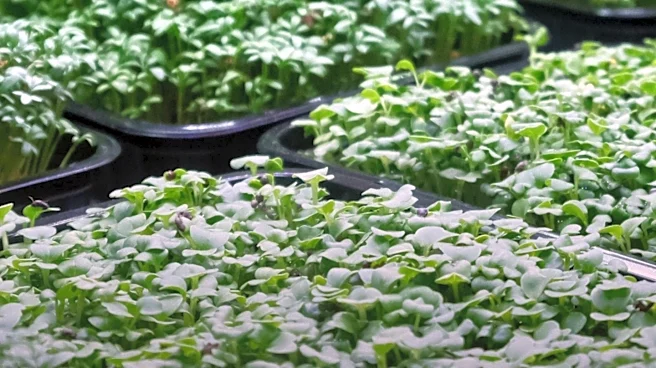
factory in the United States, has established a new research and development base in Hamura, a city in western Tokyo. The company aims to develop efficient indoor cultivation methods for various crops, including tomatoes, and to create robots for automated planting and packaging. Oishii Farm currently employs AI to manage the breeding environment for bees, crucial for pollination, which has resulted in a 95% pollination rate for its strawberries. Hiroki Koga, co-founder and CEO of Oishii Farm, highlighted that these plant factories are unaffected by seasonal changes or weather conditions, allowing for rapid agricultural progress. Additionally, NTT East Inc., a telecommunications operator, and other companies initiated an aquaponics test in Tokyo in June, combining the cultivation of Japanese 'nishikigoi' ornamental carp and ginseng.
Why It's Important?
The integration of AI and sensor technology in indoor farming in Japan holds significant implications for global agricultural practices, including potential impacts on the U.S. This technological advancement addresses critical challenges such as labor shortages and climate variability, which are not unique to Japan. For the U.S. agricultural sector, particularly in controlled environment agriculture, these innovations could offer blueprints for increasing efficiency, reducing reliance on manual labor, and ensuring consistent crop yields. Companies like Oishii Farm, with operations in the U.S., are directly transferring this expertise, potentially leading to more resilient and productive food systems. The ability to achieve rapid breeding progress, as noted by Oishii Farm's CEO, could accelerate the development of new crop varieties and improve food security. Furthermore, the aquaponics test combining fish and plant cultivation demonstrates a sustainable model that could be adopted to optimize resource use and minimize environmental impact, benefiting U.S. efforts towards sustainable agriculture and food production.
What's Next?
The ongoing advancements in AI and sensor technology for indoor farming in Japan are expected to lead to further innovations in agricultural automation and efficiency. Oishii Farm Corp. plans to continue developing efficient indoor cultivation methods for various crops and to integrate robotics for automated planting and packaging. This suggests a future where agricultural processes are increasingly mechanized and data-driven, potentially reducing operational costs and increasing output. The success of AI in managing bee breeding environments for pollination could also inspire similar applications in other controlled agricultural settings globally. The aquaponics test by NTT East Inc. and partners in Tokyo will likely provide valuable data on the feasibility and scalability of integrated aquaculture and hydroponics systems. If successful, these models could be replicated and adapted in other regions, including the U.S., to create more sustainable and resource-efficient food production systems. Continued research and development in these areas are anticipated to refine existing technologies and introduce new solutions to agricultural challenges.
Beyond the Headlines
The widespread adoption of AI and sensor technology in indoor farming signifies a broader shift towards precision agriculture and controlled environment food production. This trend has profound ethical and cultural implications, particularly concerning the future of traditional farming and rural communities. While these technologies offer solutions to labor shortages and climate challenges, they also raise questions about the potential displacement of agricultural workers and the concentration of food production in urban or technologically advanced centers. The ability to 'achieve hundreds of years' worth of traditional outdoor breeding progress within a single year' through AI-driven plant factories could fundamentally alter the genetic diversity of crops and the natural evolutionary processes. Moreover, the increasing reliance on technology for food production could lead to a disconnect between consumers and the origins of their food, potentially impacting cultural practices and dietary habits. The development of integrated systems like aquaponics also highlights a move towards closed-loop ecosystems, which, while sustainable, require significant technological oversight and energy inputs, posing new challenges for infrastructure and resource management.