





What's Happening?
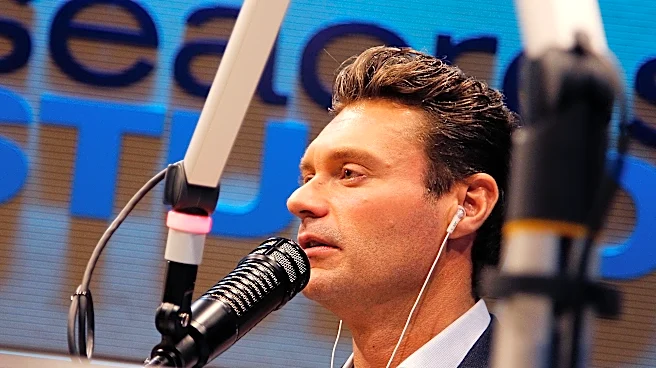
Ryan Seacrest, the radio and TV host, has disclosed a new habit of talking to himself out loud. During an episode of 'On-Air With Ryan Seacrest' on November 24, he discussed this with co-hosts Tanya Rad and Sisanie. Seacrest admitted that he addresses
himself using nicknames such as 'dude' or 'bro,' offering himself motivational phrases like 'Dude, you got this!' or 'Bro, crush this!' He also mentioned that these self-conversations sometimes include cursing. This admission came after he inquired if his co-hosts engaged in similar self-talk. While Rad generally does not, Sisanie acknowledged talking through her plans aloud. Seacrest noted he was 'struggling' with choosing between his two self-assigned nicknames. Listeners of the show reportedly related to his admission in social media comments.
Why It's Important?
This personal revelation from a prominent media personality like Ryan Seacrest highlights a common, yet often unacknowledged, human behavior: self-talk. While seemingly a quirky habit, the practice of speaking thoughts aloud can have broader implications for mental well-being and cognitive processing. Dr. Robert N. Kraft, a professor emeritus of cognitive psychology, suggests that vocalizing thoughts can promote more positive internal messages, counteracting negative self-talk. This insight is particularly relevant in a society where mental health awareness is growing, and individuals are increasingly seeking strategies for self-improvement and stress management. Seacrest's public sharing of this habit could normalize such behaviors, encouraging others to explore or acknowledge their own forms of self-dialogue, potentially fostering a more open discussion about personal coping mechanisms.
Beyond the Headlines
Beyond the immediate entertainment value of a celebrity's personal anecdote, Seacrest's self-talk habit touches upon deeper psychological and cultural aspects. The use of nicknames like 'dude' or 'bro' in self-address suggests a form of self-coaching or internal mentorship, where an individual adopts an external, supportive persona to guide themselves. This can be seen as a coping mechanism in high-pressure environments, common among public figures. Furthermore, the public's relatable reaction to his admission indicates a widespread, often private, engagement in similar behaviors. This phenomenon underscores the human need for internal validation and motivation, especially in an era of constant external scrutiny and performance demands. It also subtly challenges the societal norm that self-talk is unusual, suggesting it might be a more common and potentially beneficial practice than generally perceived.