




What's Happening?
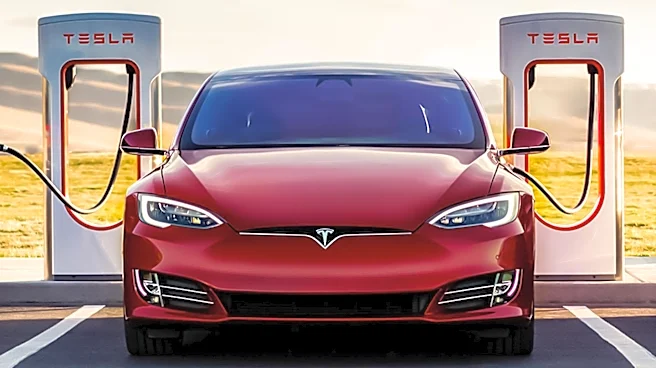
Tesla has announced that all new vehicles sold in the United United States and Mexico are now equipped with Powershare, a feature that allows owners to use their vehicle's battery to power external devices. This expansion builds on the recent integration
of Powershare into the Model 3 and Model Y in the U.S. The feature enables Tesla owners to connect tools, gadgets, and other electrical equipment directly to their vehicle's charging port. According to a post from the official Tesla North America account on X, this functionality effectively turns a Tesla into a portable battery. Tesla Energy further clarified that Powershare can also be used to power a home when paired with a Powerwall 3 in the U.S. The company had previously expanded Powershare and Vehicle-to-Load (V2L) functionality to Model 3 and Model Y vehicles ordered in the U.S. and Puerto Rico after October 1, 2026, in addition to all Cybertruck trims.
Why It's Important?
The expansion of Tesla's Powershare feature to all new U.S. vehicles marks a significant step in enhancing the utility and versatility of electric vehicles beyond transportation. This capability could be particularly impactful during power outages, offering homeowners a reliable backup power source when integrated with a Powerwall 3. For various industries, such as construction or outdoor events, the ability to power tools and equipment directly from a vehicle could reduce reliance on portable generators, potentially lowering fuel consumption and emissions. This move also positions Tesla more broadly within the energy ecosystem, aligning with its clean energy initiatives and potentially increasing the appeal of its vehicles to a wider range of consumers who value self-sufficiency and emergency preparedness. The feature could also influence other automotive manufacturers to develop similar functionalities, accelerating the integration of EVs into broader energy solutions.
What's Next?
Following this announcement, Tesla is expected to continue promoting the Powershare feature, particularly its integration with the Powerwall 3 for home energy solutions. The company may also explore further applications and partnerships to leverage this vehicle-to-load capability. There is an anticipation among Canadian Tesla owners for the feature to become available in Canada, as the official North America account's announcement did not include the country, despite previous brief advertisements of V2L capability for Model 3 and Model Y. Tesla has not yet provided a timeline for Canadian availability, but the existing regulatory environment for V2L in Canada suggests that a resolution could be forthcoming. The broader automotive industry will likely observe the adoption and impact of Powershare, potentially influencing the development of similar features in competing electric vehicles.
Beyond the Headlines
The widespread availability of Powershare in Tesla vehicles could have deeper implications for energy independence and disaster resilience. By enabling vehicles to act as mobile power sources, Tesla is contributing to a decentralized energy model, where individual consumers have greater control over their power supply. This could be particularly transformative in regions prone to natural disasters, offering a critical lifeline for communities. Furthermore, the feature blurs the lines between transportation and energy infrastructure, potentially fostering new business models and services centered around vehicle-to-grid (V2G) or vehicle-to-home (V2H) technologies. The ethical considerations around energy consumption and equitable access to such advanced features will also become more prominent as these technologies become more commonplace, prompting discussions on how to ensure these benefits are accessible to all segments of society.