




What's Happening?
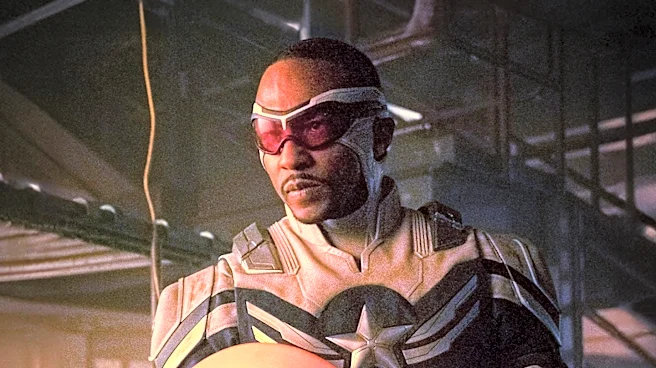
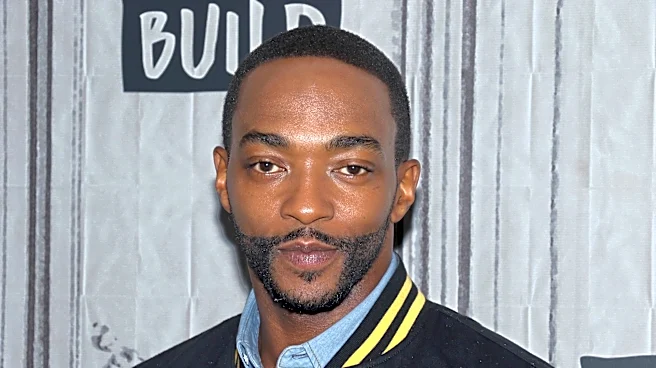
Anthony Mackie, who portrays Captain America (Sam Wilson) in the Marvel Cinematic Universe, has publicly stated his wish to star in two additional solo films to fully develop his character's narrative arc. Speaking on the 'Happy Sad Confused' podcast,
Mackie argued that every superhero character deserves a trilogy, drawing comparisons to the numerous Spider-Man films and Chris Evans' three Captain America movies. He believes that while he has led a Disney+ series and one feature film, 'Captain America: Brave New World,' his character's journey as Captain America is still in its early stages. Mackie is set to reprise his role in the upcoming 'Avengers: Doomsday,' which is scheduled for release on December 18, 2026. The actor's aspiration comes amidst mixed critical and box office reception for 'Captain America: Brave New World,' which garnered approximately $415 million worldwide and a 46% rating on Rotten Tomatoes.
Why It's Important?
Mackie's push for more Captain America films highlights a significant discussion within the entertainment industry regarding character development and franchise longevity, particularly for major studios like Marvel. His argument for a complete character arc resonates with fans who invest in long-running cinematic universes and expect thorough storytelling. The performance of 'Captain America: Brave New World' introduces a financial and critical hurdle, as studios often base future projects on past successes. If Marvel Studios greenlights additional films for Mackie, it could signal a commitment to developing diverse superhero narratives despite initial challenges. Conversely, if his request is not met, it might indicate a shift in Marvel's strategy, potentially prioritizing other characters or a broader cinematic universe reorganization, as hinted by Marvel Studios President Kevin Feige's plans for a partial MCU reboot after 'Avengers: Secret Wars.' This decision will impact not only Mackie's career but also the future direction of the Captain America mantle and the broader MCU narrative.
What's Next?
The immediate future for Anthony Mackie's Captain America involves his significant role in 'Avengers: Doomsday,' where he is expected to lead the effort to reassemble the Avengers against Doctor Doom. The success and critical reception of 'Avengers: Doomsday' could heavily influence Marvel Studios' decision regarding future solo Captain America films for Sam Wilson. Marvel Studios President Kevin Feige has also discussed a partial reboot of the MCU after 'Avengers: Secret Wars,' scheduled for December 2027. This potential restructuring could either open doors for new character developments or lead to a re-evaluation of existing character arcs, including Sam Wilson's. The return of Chris Evans as Steve Rogers in 'Avengers: Doomsday' further complicates the narrative, raising questions about how Marvel plans to manage two prominent Captain America figures within its evolving storyline. Marvel's decision will determine whether Mackie's vision for a complete trilogy for Sam Wilson's Captain America will come to fruition.
Beyond the Headlines
The desire for a complete character arc, as expressed by Anthony Mackie, touches upon deeper themes of legacy, representation, and the evolving nature of superhero narratives. Sam Wilson's journey as Captain America, particularly following Steve Rogers, carries significant cultural weight, representing a new era for the iconic shield. A full trilogy would allow for a more nuanced exploration of the challenges and responsibilities associated with inheriting such a powerful symbol, moving beyond the initial struggles depicted in 'The Falcon and the Winter Soldier' and 'Brave New World.' This could solidify Sam Wilson's unique identity as Captain America, distinct from his predecessor, and demonstrate Marvel's commitment to progressive storytelling. The industry's response to Mackie's request will also reflect on how studios balance creative vision with commercial performance, especially in a post-pandemic landscape where box office numbers are under increased scrutiny. It highlights the ongoing tension between artistic integrity and the financial realities of large-scale franchise filmmaking.