






What's Happening?
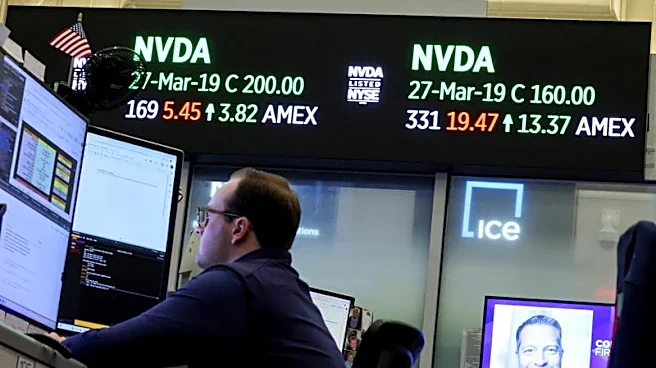
Michael Burry, the investor renowned for foreseeing the 2008 financial crisis, has reiterated his bearish perspective on Nvidia, despite having recently reduced 75% of his Nvidia put options and acquired some long-dated call options. In a November 24
post, Burry described the situation following Jensen Huang's return as president and CEO as a 'precarious normal,' asserting that his short thesis remains valid. Concurrently, Burry has increased his investments in several Chinese companies, including JD.com, Tencent, and BYD, capitalizing on their recent share price declines. He views Tencent as 'the best business in China' and a 'Fortress business,' and considers BYD an undervalued global manufacturing leader. He also added to his JD.com position, noting its substantial net cash.
Why It's Important?
Burry's dual strategy of maintaining a bearish outlook on a prominent U.S. tech giant like Nvidia while simultaneously increasing exposure to Chinese equities carries significant implications for market sentiment and investment flows. His continued skepticism towards Nvidia, even after a recent surge in its stock, suggests a belief that the company's valuation may still be inflated or that underlying issues persist. This could influence other investors to re-evaluate their positions in the AI sector. Conversely, his increased investment in Chinese companies, despite recent market weakness in Hong Kong stocks, indicates a conviction that these markets offer compelling value and growth opportunities. This move could signal a broader trend of investors seeking diversification and value outside of the U.S. market, potentially shifting capital towards emerging markets and specific sectors within China.
What's Next?
The market will closely watch Nvidia's performance and Burry's future actions regarding his short position, especially given his previous adjustments to his put options. Any further statements or portfolio changes from Burry regarding Nvidia could trigger significant market reactions. Simultaneously, the performance of his newly acquired Chinese holdings—JD.com, Tencent, and BYD—will be under scrutiny as a test of his investment thesis in these markets. If these investments prove successful, it could encourage other institutional and retail investors to explore similar opportunities in China, potentially leading to increased foreign investment in the region. Conversely, if these investments falter, it might reinforce caution among investors regarding the volatility of Chinese markets.
Beyond the Headlines
Burry's investment decisions often reflect a contrarian view, challenging conventional market wisdom. His ability to identify perceived overvaluations, as with Nvidia, and undervalued assets, as with the Chinese companies, highlights a sophisticated approach to market analysis. The 'precarious normal' description for Nvidia's situation suggests a deeper concern about market dynamics beyond immediate price movements, possibly hinting at structural or competitive challenges. His confidence in Chinese companies like Tencent and BYD, despite geopolitical tensions and market volatility, underscores a belief in their fundamental strength and long-term growth potential. This strategy also brings to light the ongoing debate about the attractiveness of U.S. versus international markets, particularly in a global economic landscape where different regions present varying risk-reward profiles.