
What's Happening?
PsiQuantum, a Palo Alto-based company specializing in quantum computing, has successfully closed a $1 billion Series E funding round. This significant investment values the company at $7 billion. The funding round was
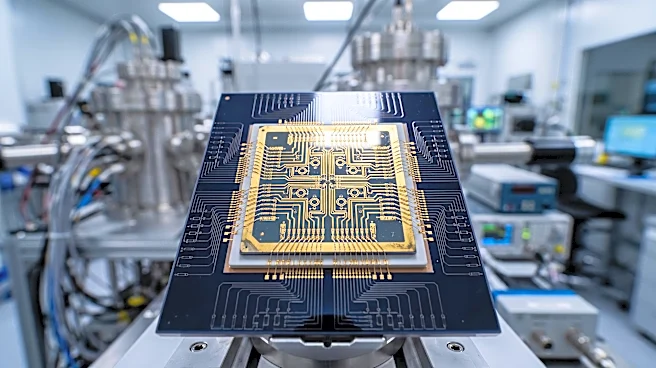
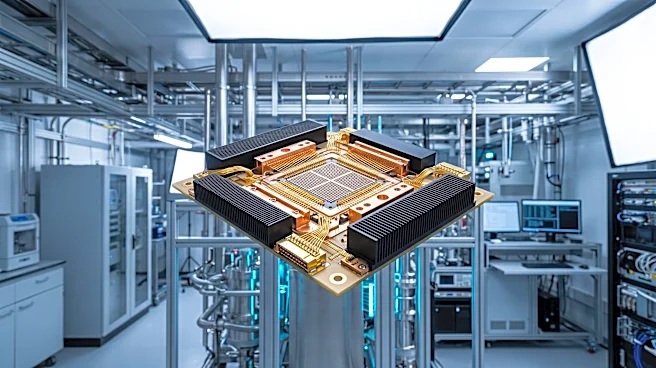
led by prominent investors including BlackRock affiliates, Temasek, and Baillie Gifford. PsiQuantum focuses on developing quantum computers that encode qubits in single particles of light traveling through silicon chips, a method known as photonics. The capital raised is earmarked for the development of new sites in Brisbane and Chicago, indicating an expansion of their operational footprint. This investment follows Nvidia's venture arm, NVentures, joining PsiQuantum's funding round in September 2025, alongside other quantum technology companies like Quantinuum and QuEra. Nvidia and PsiQuantum have also agreed to collaborate on quantum algorithms and the integration of GPUs with quantum processing units (QPUs). This strategic partnership aims to advance the capabilities of quantum computing by leveraging Nvidia's expertise in GPU technology for error correction and computational support.
Why It's Important?
This substantial funding for PsiQuantum underscores the growing investor confidence and strategic importance placed on quantum computing technology within the U.S. and globally. A $7 billion valuation highlights the perceived potential of PsiQuantum's photonic approach to quantum computing, which utilizes conventional semiconductor manufacturing processes, potentially offering a scalable path to utility-scale quantum machines. The investment will enable PsiQuantum to accelerate its research and development, potentially bringing advanced quantum computing capabilities closer to commercialization. The collaboration with Nvidia is particularly significant, as it bridges the gap between classical high-performance computing and quantum processing. This integration is crucial for addressing the complex challenges of quantum error correction and for developing hybrid quantum-classical algorithms, which are essential for practical quantum applications. Success in this area could lead to breakthroughs in various sectors, including materials science, drug discovery, and complex optimization problems, offering a competitive edge to U.S. industries that adopt these technologies early.
What's Next?
With the new $1 billion in funding, PsiQuantum is expected to proceed with the establishment and expansion of its facilities in Brisbane and Chicago. This expansion will likely involve increased hiring of quantum scientists, engineers, and technical staff, further solidifying its position in the quantum computing landscape. The ongoing collaboration with Nvidia on quantum algorithms and GPU-QPU connectivity will likely intensify, leading to further advancements in hybrid computing architectures. Future developments may include the demonstration of more robust quantum error correction techniques and the development of practical applications that leverage the combined power of quantum processors and classical GPUs. The quantum computing sector will be watching closely for PsiQuantum's progress in scaling its photonic quantum computers and for any announcements regarding the performance and capabilities of its next-generation systems. The success of these initiatives could influence further investment trends and partnerships within the rapidly evolving quantum technology ecosystem.
Beyond the Headlines
PsiQuantum's significant funding and strategic partnerships reflect a broader trend of convergence between quantum computing and artificial intelligence, driven by companies like Nvidia. While quantum computing and AI have sometimes been viewed as distinct fields, the integration efforts, particularly in areas like quantum error correction and algorithm development, suggest a future where these technologies are deeply intertwined. The use of silicon photonics by PsiQuantum also highlights a potential shift in quantum hardware development, leveraging existing semiconductor manufacturing infrastructure to overcome scalability challenges. This approach could democratize access to quantum computing by reducing the need for highly specialized fabrication facilities. However, the long-term implications also include ethical considerations regarding the power of such advanced computational capabilities, potential impacts on national security, and the need for robust regulatory frameworks to govern the development and deployment of quantum technologies. The race to achieve fault-tolerant quantum computing continues, with significant economic and geopolitical stakes.