




What's Happening?
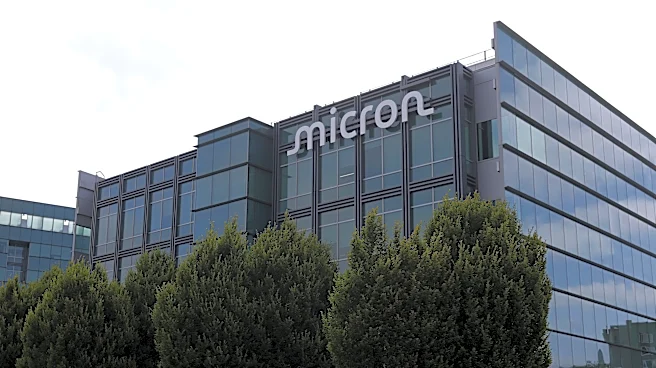
Micron's president, Scott DeBoer, stated on November 18 that Artificial Intelligence (AI) is deeply integrated into the company's product development processes. Micron is aiming to halve design times and double the number of designs produced with the same
workforce. This strategic shift comes as Micron experiences rapid growth in its High-Bandwidth Memory (HBM) revenues, which are outpacing overall company revenue growth. The company has already secured agreements for the majority of its calendar year 2027 HBM supply, noting significant year-over-year price increases. Micron is also advancing its HBM4 development and collaborating with NVIDIA on a custom HBM4E implementation, known as NVHBM, for future GPU and NVLink Fusion platforms. DeBoer emphasized that the memory business has evolved significantly, particularly with the advent of AI, transforming its historical role as a commodity.
Why It's Important?
The integration of AI into Micron's design processes is crucial for the U.S. semiconductor industry, as it promises to enhance efficiency and innovation in memory chip development. By accelerating design cycles and increasing output per engineer, Micron can better meet the surging demand for advanced memory solutions, especially those required for AI applications. This move could strengthen the U.S.'s competitive edge in the global chip market, reducing reliance on foreign manufacturing and intellectual property. The ability to produce more custom HBM designs with existing staff allows Micron to support a wider customer base, including key partners like Marvell Technology, which named Micron as a partner for custom HBM for its AI chips. This efficiency gain is particularly vital during periods of high demand and could provide a significant advantage during future market downturns by maintaining customer relationships and optimizing R&D costs.
What's Next?
Micron's continued focus on AI integration is expected to lead to more efficient and rapid development of next-generation memory technologies like HBM4 and NVHBM. The company's increased R&D investment, which climbed 49% to $5.65 billion in fiscal 2026, is aimed at supporting more customer demands and co-designing products for future applications. While faster design cycles will not immediately increase wafer production, which is limited by new fabrication plant construction (with the first new Boise fab expected to produce wafers by mid-2027), they will enable Micron to take on more custom work. Upcoming reports from partners like Marvell Technology on December 1 and Synopsys on December 8, followed by Micron's own fiscal first-quarter results on December 17, will provide further insights into the demand for custom HBM and the impact of these AI-driven efficiencies.
Beyond the Headlines
The shift towards AI-driven design at Micron signifies a broader transformation within the semiconductor industry, moving away from traditional, labor-intensive design processes. This evolution has profound implications for workforce development, potentially requiring new skill sets in AI and automation for engineers. While it promises increased productivity, it also raises questions about the future of employment in design roles. Furthermore, the emphasis on custom HBM solutions highlights a trend towards specialized memory tailored for specific AI workloads, moving beyond generic memory products. This customization could lead to deeper partnerships between memory manufacturers and AI chip developers, fostering a more integrated and interdependent ecosystem. The long-term impact could be a more resilient and adaptable U.S. semiconductor industry, better equipped to navigate market fluctuations and technological advancements.