







What's Happening?
Climate Fund Managers (CFM) has received approval for $140 million in catalytic financing from the Green Climate Fund (GCF) to advance industrial decarbonization and green hydrogen infrastructure in Southern Africa. This funding, approved on October 28,
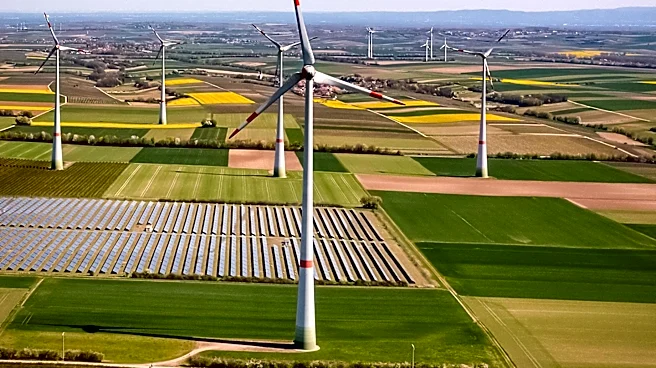
2026, will support Climate Investor Three (CI3), a global blended finance facility. The GCF's 46th Board meeting in Songdo, South Korea, sanctioned the financing, which aims to attract additional private investment towards CI3's $1.2 billion fundraising target. The Southern African Industrial Decarbonization Facility (SIDF) will provide this financing, with the Development Bank of Southern Africa (DBSA) overseeing the program. The blended finance structure is designed to mitigate development and construction risks, making projects more appealing to institutional and commercial investors. The initiative targets 30 to 40 industrial decarbonization projects, aiming to install approximately 1.52 gigawatts (GW) of renewable energy capacity and avoid an estimated 24.2 million tonnes of greenhouse gas emissions. Investment priorities include green hydrogen production, green ammonia, green methanol, and infrastructure supporting lower-carbon industrial value chains.
Why It's Important?
This GCF approval is crucial for accelerating the energy transition in Southern Africa, a region facing significant challenges in decarbonizing its industrial sector due to high upfront costs and development risks. By providing catalytic financing, the GCF aims to de-risk these projects, thereby attracting much-needed private capital and fostering competitive, low-carbon industrial growth. The investment in green hydrogen, ammonia, and methanol production, alongside renewable energy capacity, positions Southern Africa as a potential leader in emerging green industries. This initiative could create new economic opportunities, reduce reliance on fossil fuels, and contribute significantly to global climate goals. The success of this program will demonstrate a viable model for blended finance in developing regions, potentially influencing future climate finance strategies and encouraging similar investments in other parts of the world. It also highlights the growing recognition of industrial decarbonization as a critical component of the global fight against climate change.
What's Next?
The immediate next steps involve mobilizing additional private capital to reach CI3's $1.2 billion fundraising target. Following this, individual projects within the Southern African Industrial Decarbonization Facility (SIDF) will need to reach financial close. The funding builds on existing investment commitments and project development activities in South Africa and Namibia, with SA-H2 and SDG Namibia One Fund already having signed development funding agreements for various green hydrogen and e-fuels projects. The long-term impact will depend on the successful implementation of these projects, their ability to deliver measurable emissions reductions, and their contribution to industrial and economic development in the region. The Development Bank of Southern Africa (DBSA) will play a key role in program oversight, monitoring, and reporting, ensuring accountability and progress towards the stated goals. The initiative's success could pave the way for further international investment in similar decarbonization efforts across Africa.
Beyond the Headlines
This financing initiative extends beyond mere financial investment; it represents a strategic effort to address the complex interplay between economic development, energy security, and climate action in Southern Africa. By focusing on green industrialization, the program aims to create sustainable jobs and foster local value chains, moving beyond traditional resource extraction models. The emphasis on green hydrogen and its derivatives signals a shift towards future-proof industries that can provide long-term economic stability and environmental benefits. Furthermore, the blended finance approach, utilizing catalytic capital to attract private investment, could serve as a blueprint for overcoming financial barriers to climate action in other developing economies. This model acknowledges that public funds alone are insufficient to meet the scale of investment required for a global energy transition and seeks to leverage private sector innovation and capital for broader impact. The ethical implications revolve around ensuring equitable distribution of benefits and avoiding potential pitfalls of large-scale industrial projects, such as land use conflicts or environmental justice concerns.