






What's Happening?
A study is assessing the effects of mechanization and the use of draft animals on agricultural intensification in Tanzania, specifically focusing on rice farming. The research utilizes a multinomial endogenous switching regression (MESR) framework with
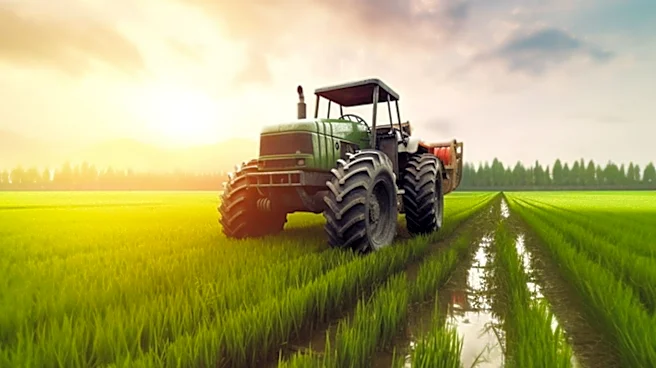
a panel dataset collected in 2018 and 2025. Tanzania serves as a suitable case study due to the concurrent use of four-wheel tractors (4WTs), two-wheel tractors (2WTs), draft animals (DAs), and hand tools (HTs) in its agricultural practices. The initial findings indicate that 4WTs, 2WTs, and DAs significantly reduce labor requirements for land preparation compared to HTs. However, the study highlights varying impacts on the adoption of rice technologies, cultivation practices, and overall productivity.
Why It's Important?
This research is significant for understanding sustainable agricultural development in sub-Saharan Africa, a region where agricultural intensification has long been a critical development issue. By analyzing the differential impacts of various mechanization levels, the study can inform policy decisions and investment strategies aimed at improving food security and farmer livelihoods. The findings suggest that 2WTs have the most substantial positive effect on yield, income, and profit per hectare, primarily because they facilitate labor-intensive cultivation practices and greater use of hired labor, particularly for puddling and harrowing. Conversely, the use of ride-on 4WTs for plowing does not appear to correlate with a corresponding intensification of rice farming, indicating that not all forms of mechanization lead to increased productivity or advanced farming techniques. This distinction is crucial for optimizing resource allocation and promoting effective agricultural modernization.
What's Next?
The ongoing analysis of the panel dataset from 2018 and 2025 will likely provide more comprehensive insights into the long-term effects of mechanization on rice farming in Tanzania. Future steps will involve disseminating these findings to policymakers, agricultural organizations, and farmers to guide the adoption of appropriate technologies. The study's conclusions could influence agricultural extension services, credit programs for farmers, and government subsidies for specific types of farm machinery. There is potential for further research to explore the socio-economic factors influencing farmers' choices in adopting different mechanization levels and to assess the environmental sustainability of these practices. The insights gained could also be applied to other sub-Saharan African countries facing similar agricultural development challenges.
Beyond the Headlines
The study's nuanced findings on mechanization underscore a broader challenge in agricultural development: the need for context-specific solutions. While mechanization is often seen as a panacea for increasing agricultural output, this research demonstrates that the type of mechanization matters significantly. The greater impact of 2WTs on yield and profit suggests that smaller, more adaptable machinery might be more effective in promoting intensive cultivation practices and generating economic benefits for smallholder farmers in certain contexts. This challenges a 'one-size-fits-all' approach to agricultural modernization and highlights the importance of considering local ecological conditions, labor markets, and existing farming practices. The study also implicitly touches upon the ethical considerations of technology adoption, ensuring that new tools genuinely empower farmers and contribute to sustainable development rather than simply replacing labor without corresponding productivity gains.