





What's Happening?
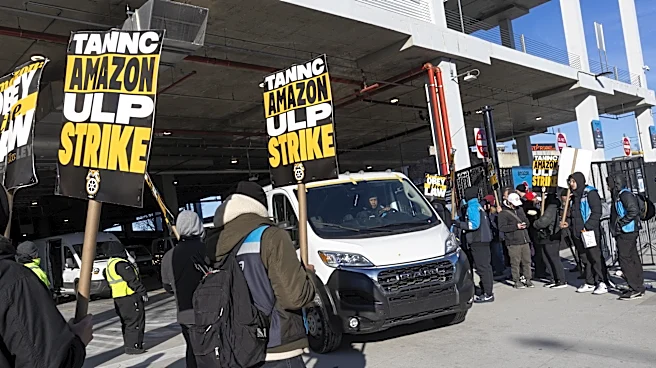
Amazon workers in over 20 countries are organizing strikes and protests from November 27 to November 30, coinciding with Black Friday, to demand a larger share of the company's profits. The 'Make Amazon Pay' coalition, founded in 2020 by over 80 unions
and campaign groups, is leading these actions. Their demands include decent wages, safe working conditions, union rights, fair taxation, and climate justice. This initiative comes as Amazon reported a profit of $20.7 billion between July and September 2026, averaging $225 million per day. Despite these profits, a full-time U.S. warehouse employee's starting pay is stated as $20 an hour, or $41,600 annually before tax. The company also plans to invest heavily in AI data centers and aims to use robots to avoid hiring over 600,000 U.S. workers by 2033, raising concerns about job security.
Why It's Important?
These planned strikes highlight growing labor tensions within one of the largest U.S. corporations and have significant implications for the American economy and labor movement. The 'Make Amazon Pay' campaign challenges the current distribution of wealth, arguing that Amazon's substantial profits are not adequately shared with its workforce. This movement could galvanize broader discussions about corporate responsibility, worker rights, and income inequality in the U.S. If successful, these actions could pressure Amazon and other large companies to re-evaluate their compensation structures and labor practices, potentially leading to higher wages and improved working conditions across the retail and logistics sectors. The focus on Black Friday, a critical shopping period, aims to maximize disruption and draw public attention to the workers' demands, potentially impacting consumer behavior and corporate revenues during a peak sales event. The long-term success of such movements could reshape labor relations and corporate governance in the U.S.
What's Next?
The upcoming Black Friday strikes will test the resolve of Amazon workers and the effectiveness of the 'Make Amazon Pay' coalition. The immediate impact will be observed in potential disruptions to Amazon's operations and delivery services during one of the busiest shopping periods. The company's response to these actions will be crucial; last year, an Amazon spokesperson dismissed the campaign as "intentionally misleading." However, continued pressure could force Amazon to engage in more substantive negotiations or face ongoing public relations challenges and potential regulatory scrutiny. The outcome of these strikes could also influence legislative efforts related to labor rights, minimum wage, and corporate taxation in the U.S. Furthermore, the campaign's global nature suggests a coordinated effort that could set precedents for labor movements in other multinational corporations, potentially leading to a more unified approach to worker advocacy across different countries.
Beyond the Headlines
The 'Make Amazon Pay' campaign transcends immediate labor disputes, touching upon fundamental questions about economic justice and the future of work in an increasingly automated world. The statistic that Jeff Bezos's $361 billion net worth would take an Amazon worker 8.7 million years to earn underscores the vast wealth disparity that fuels these protests. The company's plan to replace human workers with robots by 2033 raises ethical concerns about job displacement and the societal responsibility of corporations to their workforce. This situation highlights the tension between technological advancement and human employment, prompting a broader societal debate on how to manage the transition to automation without exacerbating inequality. The campaign's demands for fair taxation also point to the role of government in regulating corporate profits and ensuring that wealth contributes to public services, rather than solely accumulating at the top. This movement is part of a larger global conversation about rebalancing economic power and ensuring a more equitable future.