





What's Happening?
The discussion around the economic implications of artificial intelligence is increasingly focusing on the ownership of AI agents and their output. This shift comes as AI systems are projected to perform a significant portion of future work, leading to proposals
for how humans will derive income. Initial ideas, such as universal basic income funded by federal checks, are evolving towards models emphasizing collective ownership. For instance, Sam Altman, initially a proponent of basic income, now favors collective ownership through stakes in AI compute or equity. OpenAI's policy paper, 'Industrial Policy for the Intelligence Age,' suggests a Public Wealth Fund to give every American a stake in AI companies and infrastructure, alongside tax shifts from labor to capital and subsidized four-day workweeks. These proposals reflect a growing consensus among AI developers and policymakers that the economic structure will fundamentally change as AI agents become central to productivity. The core question is moving from 'who gets a check' to 'who owns the agents' and 'who owns what they produce' in an economy increasingly driven by AI.
Why It's Important?
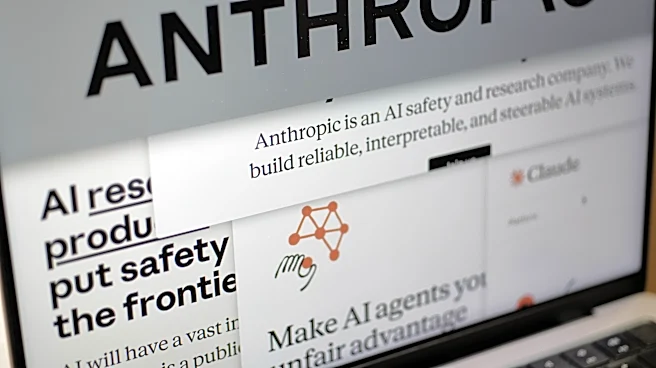
The debate over AI ownership is crucial because it addresses fundamental questions about economic power, individual leverage, and societal structure in an AI-driven future. If AI agents perform most work, traditional forms of leverage like employment and bargaining power could diminish. The current trajectory suggests an economy where billions of AI agents work for individuals and companies, necessitating clarity on who controls these agents and their generated value. This has significant implications for wealth distribution, as evidenced by Anthropic's recent IPO, which saw substantial retail investor interest, indicating a public desire for direct ownership in AI companies. The shift from a 'handover economy'—where AI systems allocate resources to humans—to one where individuals own or direct their AI agents, could prevent a scenario where a few AI labs and platforms control the majority of economic output. This directly impacts the future of work, capital distribution, and the potential for widespread economic participation versus a concentration of wealth and power.
What's Next?
The immediate future will likely see continued development and refinement of proposals for AI ownership and economic integration. As AI companies like OpenAI and xAI potentially go public, the opportunity for broader public ownership in these entities will expand, influencing how wealth generated by AI is distributed. Legislative efforts, such as those proposed by Representatives Sara Jacobs, Greg Casar, and Valerie Foushee for taxing large AI companies to fund jobs, indicate a growing governmental interest in shaping the economic impact of AI. Further discussions will likely focus on the practical mechanisms for individuals to own and direct their AI agents, as well as the regulatory frameworks needed to ensure fair competition and prevent monopolistic control over AI infrastructure. The ongoing evolution of AI agent payment protocols and commerce standards will also define how these agents interact economically, shaping the landscape for businesses and individuals alike.
Beyond the Headlines
Beyond the immediate economic and policy discussions, the question of AI ownership delves into deeper ethical and societal implications. If AI agents become central to economic activity, the concept of 'work' itself may transform, challenging traditional notions of purpose and contribution. The potential for a 'rentier state' model, where governments and corporations no longer rely on human labor and thus have less incentive to cater to citizen needs, raises concerns about democratic accountability and social cohesion. Ensuring widespread ownership of AI agents and the underlying infrastructure could be a critical safeguard against such disempowerment, fostering a more pluralistic economy where individuals retain agency and leverage. This shift also presents a unique opportunity to redefine economic participation, moving beyond a purely labor-based model to one that values ownership, direction, and innovation in an AI-augmented world. The long-term societal impact hinges on whether AI becomes a tool for broad empowerment or further concentrates power and wealth.