




What's Happening?
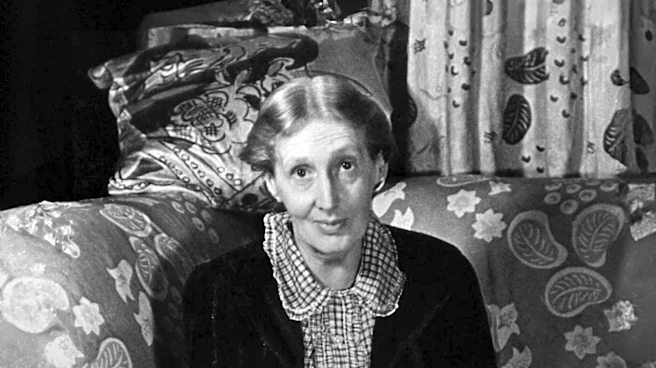
A fourth-floor apartment in the Victorian house at 22 Hyde Park Gate, London, where author Virginia Woolf was born and raised, has been listed for sale at approximately $2.6 million (1.9 million British pounds). The property, managed by DDRE Global, is notable
for its significant literary history, marked by three English Heritage blue plaques commemorating Woolf, her sister and painter Vanessa Bell, and their father, literary critic Sir Leslie Stephen. Woolf, born in the house on January 25, 1882, described her childhood home as an oppressive environment with numerous small, oddly shaped rooms. Despite this, it was here that she began to develop her literary impulses. After Leslie Stephen's death in 1904, the family moved to Gordon Square, where Woolf and Bell established the Bloomsbury Group, an influential cultural movement of the 20th century.
Why It's Important?
The sale of this historic property underscores the enduring cultural and literary legacy of Virginia Woolf, a central figure in literary modernism. Her works, including 'Mrs. Dalloway,' 'To the Lighthouse,' and 'The Waves,' along with her foundational feminist essay 'A Room of One’s Own,' continue to be studied globally. The house itself is a tangible link to the origins of the Bloomsbury Group, which profoundly influenced English literature and art. The property's unique historical significance, highlighted by its multiple heritage plaques, positions it as a rare offering in the British real estate market, appealing to buyers interested in cultural heritage. This event also draws attention to the broader preservation of literary landmarks, as another property linked to Woolf in Cornwall faces development controversy.
What's Next?
The apartment, which has undergone a comprehensive renovation, features two bedrooms, two bathrooms, a kitchen, and a spacious living room, with custom carpentry and original sash windows. The sale process will determine who acquires this piece of British cultural history. Meanwhile, a separate controversy surrounds a property in St. Ives, Cornwall, frequented by Woolf, where a new five-story building has been approved, threatening the views that inspired her novel 'To the Lighthouse.' This highlights ongoing challenges in balancing development with the preservation of sites significant to literary and cultural heritage. The outcome of the sale and the Cornwall development will continue to shape the physical landscape associated with Woolf's life and work.
Beyond the Headlines
The listing of Woolf's childhood home for sale transcends a mere real estate transaction, touching upon themes of memory, legacy, and the commodification of cultural heritage. Woolf's own descriptions of the house as 'a dwelling of innumerable small and oddly shaped rooms' and an 'oppressive' environment offer a poignant contrast to its current market presentation as 'beautifully balanced, elegant and discreetly contemporary.' This juxtaposition raises questions about how historical spaces are reinterpreted and valued in contemporary society. The controversy in Cornwall further emphasizes the tension between economic development and the preservation of intangible cultural value, particularly when it involves landscapes that inspired seminal literary works. The sale of such a property invites reflection on the personal and collective narratives embedded within physical structures and their role in shaping identity and artistic expression.