
What's Happening?
Tesla is rolling out its Full Self-Driving (FSD) v15 software, which includes significant safety improvements and collision avoidance systems, as confirmed by Tesla AI chief Ashok Elluswamy. This new version is reportedly 25 times better at handling safety-critical
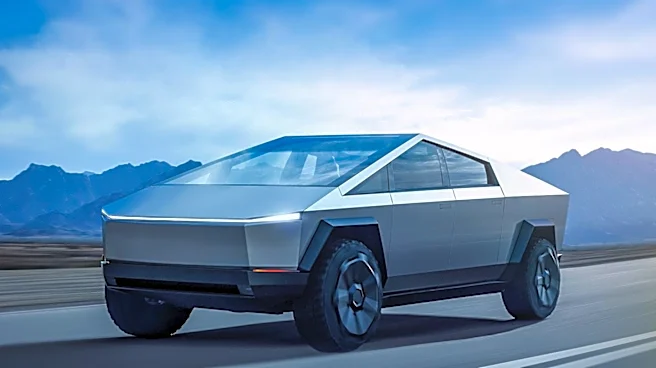
cases compared to v14. Concurrently, Elon Musk announced plans to integrate Starlink directly into every Tesla model by the end of next year, with the exception of China where Starlink is illegal. This integration is deemed crucial for enabling unsupervised FSD, providing high-bandwidth connectivity for passengers for work and entertainment. Currently, only the Cybercab features a flush-mounted Starlink V5 terminal, primarily used for navigation, customer service, and fleet management, rather than direct safe driving functions. The timing of these developments aligns with Tesla's goal of launching its Robotaxi network, with trials potentially starting next month.
Why It's Important?
The integration of Starlink with Tesla's FSD v15 marks a pivotal step towards achieving fully unsupervised autonomous driving. Enhanced connectivity through Starlink could significantly improve the reliability and functionality of FSD by providing consistent, high-speed data for navigation, real-time updates, and potentially remote assistance. This development could accelerate Tesla's Robotaxi ambitions, transforming urban mobility and potentially disrupting traditional ride-sharing and taxi services. For consumers, the promise of high-bandwidth internet in their vehicles could redefine in-car experiences, making long commutes or road trips more productive and entertaining. However, the exclusion of China from Starlink integration highlights geopolitical and regulatory challenges that could limit the global rollout and impact market penetration in key regions. The success of FSD v15 and Starlink integration will be critical for Tesla's long-term strategy in both the automotive and technology sectors.
What's Next?
Tesla plans to make Starlink available in all its models, excluding those in China, by the end of next year, which will be a key enabler for unsupervised FSD. The company is also expected to begin trials for its Robotaxi network as early as next month, leveraging the capabilities of FSD v15. Further details on which vehicles will receive the AI4.5 computer and its pricing for Starlink integration outside the Cybercab are yet to be announced. The company's focus on AI5 for Optimus, rather than cars, suggests a strategic shift in hardware allocation, with AI4 deemed sufficient for 'superhuman driving.' The market will closely watch the performance of FSD v15 and the rollout of Starlink integration, as these developments will significantly influence Tesla's position in the autonomous vehicle and connected car markets.
Beyond the Headlines
The convergence of advanced AI in FSD and satellite internet connectivity through Starlink raises profound implications for data privacy, cybersecurity, and regulatory frameworks. As vehicles become increasingly autonomous and connected, the volume of data collected and transmitted will surge, necessitating robust protections against breaches and misuse. The ethical considerations of unsupervised autonomous driving, particularly concerning liability in accidents, will also become more pressing. Furthermore, the widespread adoption of Starlink in vehicles could reshape the telecommunications landscape, potentially challenging existing mobile network operators. The strategic decision to exclude China from Starlink integration underscores the growing fragmentation of global technology ecosystems, driven by national security concerns and data sovereignty. This dual advancement by Tesla could set new industry standards, pushing competitors to innovate rapidly in both AI and connectivity to remain competitive.