






What's Happening?
Bouldering training is evolving with a focus on mastering the initial moves of a climb, as recommended by climbing coach Tom Randall. Traditional bouldering often sees climbers using standard starting positions, which, while accessible for a general gym
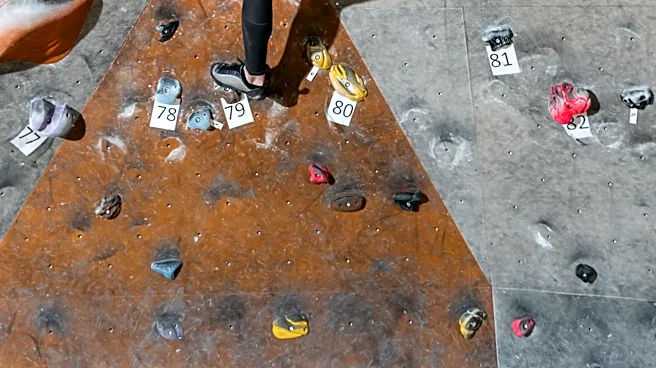
population, may not fully challenge a climber's skills. Randall advocates for four specific techniques to vary the first move: the one-foot start, the hand-foot match, the high-foot flag, and the dynamic smear. These methods push climbers beyond conventional approaches, forcing them into positions that demand greater flexibility, balance, and creative problem-solving. The one-foot start involves placing a foot on the highest reachable foothold, often rejecting lower, more comfortable options. The hand-foot match requires placing a foot on the same surface as a hand, promoting balance and center of gravity management. The high-foot flag uses a single, often 'wrongly' placed, low foot to generate tension and pressure. Lastly, the dynamic smear involves placing feet on a blank panel, forcing dynamic movements to reach the next holds. These techniques are designed to be practiced on problems well within a climber's limit, focusing on movement quality rather than just topping out.
Why It's Important?
This shift in bouldering training is important because it addresses a common oversight in climber development: the underutilization of the start of a boulder problem as a training opportunity. By intentionally varying initial movements, climbers can significantly enhance their fundamental skills, which are crucial for tackling more difficult problems. The techniques proposed by Tom Randall challenge flexibility, power generation from compressed positions, and the ability to find creative solutions in unconventional body positions. This approach helps climbers develop a deeper understanding of their body mechanics and how to apply force effectively, especially when holds are scarce or poorly positioned. For the climbing community, this means a more holistic training regimen that moves beyond simply repeating problems. It encourages experimentation and a 'rebellion' against the setter's intended beta, fostering a more adaptable and skilled climbing population. This can lead to fewer plateaus in progress and a more robust skill set applicable to both indoor and outdoor climbing scenarios, where varied and unexpected starting positions are common.
What's Next?
Climbers are encouraged to integrate these varied starting techniques into the beginning of their bouldering sessions, when they are fresh and focused. This approach is not about sending harder problems immediately but about improving movement quality and problem-solving abilities. The expectation is that by consistently practicing these techniques, climbers will develop a broader range of motion, better balance, and increased confidence in dynamic movements. This could lead to a more creative and efficient approach to bouldering, allowing climbers to unlock solutions to problems they previously found impossible. Gyms and coaches might increasingly incorporate these methods into their training programs, recognizing the value of challenging conventional starts. The long-term impact could be a generation of climbers with superior foundational skills, capable of adapting to diverse bouldering challenges and pushing the boundaries of the sport.
Beyond the Headlines
The emphasis on varied starting techniques in bouldering training highlights a broader principle applicable to many skill-based activities: the importance of deconstructing and re-evaluating fundamental actions. Often, individuals become accustomed to standard approaches, which, while effective for basic execution, can limit growth and innovation. By deliberately introducing 'uncomfortable' or 'counterintuitive' variations to the very first step, bouldering training encourages a mindset of continuous experimentation and adaptation. This fosters not just physical prowess but also cognitive flexibility and creative problem-solving. It challenges the notion of a single 'correct' way to approach a task, promoting a more fluid and responsive engagement with challenges. This philosophical shift can empower individuals to break free from ingrained habits and discover novel solutions, ultimately leading to more profound skill development and a deeper appreciation for the nuances of their chosen activity.