





What's Happening?
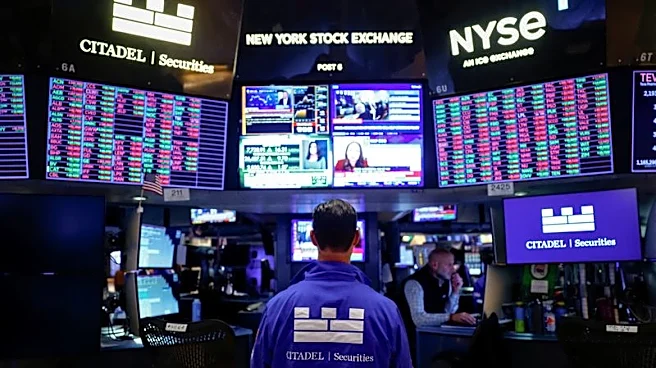
Investors in artificial intelligence (AI) are increasingly seeking financial protection against potential losses, driven by growing concerns about a possible downturn in the tech sector. This comes after a significant tech stock selloff on Friday, which
wiped out over $1 trillion in market value, with the Nasdaq 100 falling 3.4% and the S&P 500's technology sector declining more than 4.2%. Investors and technology executives are turning to financial instruments such as put options, which grant the right to sell shares at a predetermined price, and credit-default swaps, which protect against debt defaults. The cost of insuring against debt defaults by major tech companies like Amazon, Alphabet, Microsoft, Meta, and Oracle has risen to its highest level since 2021, indicating broad market concern.
Why It's Important?
The increased demand for hedging instruments signals a shift in investor sentiment from aggressive growth pursuit to wealth preservation within the AI sector. This move is critical because it reflects a growing acknowledgment of the financial risks associated with the massive capital expenditures required for AI infrastructure development. Rising borrowing costs for data center projects and chip purchases, coupled with falling share prices, are contributing to this cautious outlook. The use of put options and credit-default swaps indicates that investors are preparing for potential downside scenarios, which could lead to increased market volatility and a re-evaluation of AI company valuations. This trend could also impact the availability and cost of funding for AI companies, as lenders and investors become more risk-averse.
What's Next?
The demand for financial protection is expected to continue as AI companies pursue billions in funding for infrastructure development and expansion. The elevated trading in put options, such as those tied to AI cloud infrastructure company CoreWeave, suggests that investors anticipate further market fluctuations. The rising cost of credit-default swaps for major tech companies indicates that concerns about debt repayment are widespread across the sector. This environment may lead to more stringent financial scrutiny for AI companies seeking capital, potentially slowing down some development projects or forcing companies to prioritize profitability over rapid expansion. The market will be closely watching for any signs of stabilization or further deterioration in the financial health of these tech giants.
Beyond the Headlines
The widespread hedging against AI tech stock losses points to a deeper underlying concern about the long-term sustainability and profitability of the current AI boom. This could be a precursor to a more fundamental re-assessment of the AI industry's business models and valuation metrics. The use of sophisticated financial instruments like credit-default swaps also highlights the increasing complexity of managing risk in a rapidly evolving technological landscape. Furthermore, the fact that some investors are 'quitting to hedge their stock' suggests that even those who have made substantial gains are prioritizing capital preservation, which could lead to a broader exodus of capital from speculative AI ventures. This trend could also influence regulatory bodies to examine the financial stability of the tech sector and the potential systemic risks associated with concentrated investments in AI.