








What's Happening?
Planted, a California-based company specializing in autonomous solar power deployment, has successfully raised $31.8 million in a funding round. This capital infusion is intended to expand its robotic fleet and support the launch of its next-generation
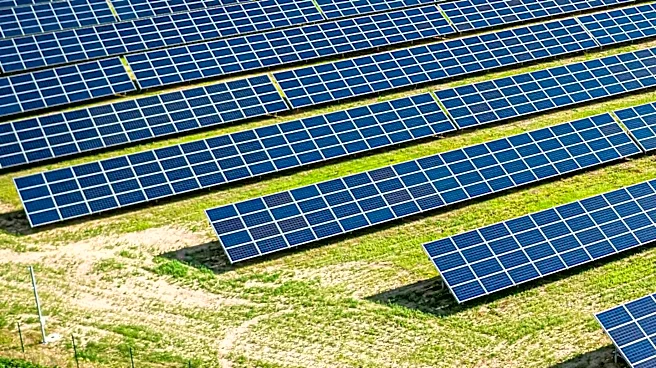
robot, Sage, to meet increasing demand. The funding round was led by Piva Capital and RA Capital Management Planetary Health, with significant participation from Gigascale Capital, Khosla Ventures, Google, and Bill Gates-founded Breakthrough Energy Ventures (BEV). According to Eric Brown, CEO of Planted, the global solar industry needs to deploy power five times faster than its current rate to meet projected demands by 2050. Planted aims to address this gap by transforming solar plant construction into a manufacturing problem, utilizing robots and deployment systems. The company's technology combines planning software, high-density terrain-following solar arrays, storage, and field robotics to build on land parcels typically unusable by traditional trackers, delivering twice the energy per acre with a smaller footprint. Planted has already demonstrated its model with projects like the 28-MW behind-the-meter facility for a neocloud data center, completed in 10 months, and the 11-MW Bowes Solar project in Illinois.
Why It's Important?
This significant investment in Planted underscores a critical shift in the renewable energy sector, particularly in the U.S., towards automation and efficiency to accelerate solar deployment. The current pace of solar installation is insufficient to meet future energy demands, and traditional construction methods face constraints in supply chains, land availability, interconnection, and skilled labor. Planted's approach, which treats power plant construction as a manufacturing process, offers a scalable solution to these challenges. By enabling faster deployment—months instead of years—and optimizing land use, the company can significantly contribute to the U.S.'s clean energy goals and reduce reliance on fossil fuels. The involvement of major investors like Google and BEV signals strong confidence in Planted's technology and its potential to disrupt the solar industry. This development could lead to more rapid grid modernization, lower energy costs, and increased energy independence for the U.S., while also creating new opportunities in robotics and advanced manufacturing within the energy sector.
What's Next?
Planted plans to deploy its next-generation robot, Sage, later this year, which is expected to further enhance its operational capacity and efficiency. The company is on track to increase its deployment from over 10 MW in 2025 to 100 MW in 2026, representing a tenfold increase. With a project pipeline exceeding 20 GW, Planted is poised for substantial growth. The success of its autonomous deployment model could encourage broader adoption of similar robotic solutions across the solar industry, potentially leading to increased competition and innovation in renewable energy construction. Furthermore, the company's ability to build on challenging terrains and deliver higher energy output per acre could open up new development sites, expanding the overall potential for solar energy generation in the U.S. The continued scaling of Planted's operations will be closely watched as a benchmark for how quickly and efficiently autonomous technologies can transform large-scale infrastructure projects.
Beyond the Headlines
The investment in Planted highlights a broader trend of industrial automation and robotics being applied to address complex infrastructure challenges. This move towards 'manufacturing' power plants rather than custom-building them could redefine the labor market in the energy sector, shifting demand from traditional construction roles to those requiring expertise in robotics, software engineering, and advanced manufacturing. Ethically, the increased efficiency and reduced land footprint of Planted's arrays could mitigate environmental impacts associated with large-scale solar farms, such as habitat disruption. However, the reliance on automation also raises questions about job displacement in conventional construction. The long-term implications include a potential acceleration of the energy transition, making renewable energy more accessible and affordable, and positioning the U.S. as a leader in innovative energy deployment technologies. This technological leap could also influence policy decisions regarding land use for energy projects and workforce development initiatives.