






What's Happening?
WeRide, a global leader in autonomous driving technology, announced that its WRD 3.0 advanced driver-assistance system (ADAS) has secured its ninth championship title at the Nanchang round of the China Urban Intelligent Driving Competition. Two production
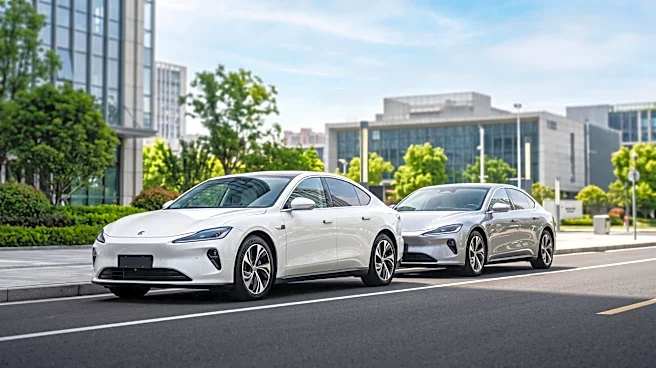
vehicles equipped with WRD 3.0, the 2027 AION i60 and the GAC Trumpchi YUE7, took the top two positions in the competition. The AION i60 finished first in the final round without requiring any driver takeover, a unique achievement among competitors. The GAC Trumpchi YUE7 secured second place in its debut at the event. This marks the first time in the competition's history that two mass-production vehicles utilizing the same intelligent driving solution from a single technology provider have achieved first and second place in the final round at the same location. WeRide emphasizes that this performance underscores its strategy to expand the commercial adoption of its intelligent driving technology among automotive manufacturers, integrating its ADAS into existing product ranges rather than solely focusing on its own autonomous vehicle operations.
Why It's Important?
This achievement by WeRide highlights the growing maturity and competitive edge of Chinese autonomous driving technology providers in the global market. The successful deployment of WRD 3.0 in mass-production vehicles like the AION i60 and GAC Trumpchi YUE7 demonstrates a viable pathway for integrating advanced driver-assistance systems into consumer automobiles. This could accelerate the adoption of ADAS features, enhancing vehicle safety and driving convenience for a broader consumer base. For automotive manufacturers, partnering with technology providers like WeRide offers a way to rapidly incorporate cutting-edge intelligent driving capabilities without extensive in-house development. This competition result also signals increasing competition for established global players in the autonomous driving sector, as Chinese firms continue to innovate and prove their systems' capabilities in rigorous testing environments. The zero-takeover performance of the AION i60 is a significant milestone, indicating a high level of reliability and sophistication in WeRide's ADAS.
What's Next?
Following this ninth championship, WeRide is likely to leverage this success to further its commercial partnerships with automotive manufacturers, both domestically and internationally. The company's strategy of supplying intelligent driving technology to established carmakers suggests an increased focus on securing more design wins and integrating WRD 3.0 into a wider range of production vehicles. This could lead to more vehicles on the market featuring WeRide's ADAS, expanding its footprint in the automotive industry. The continuous refinement of WRD 3.0, supported by nearly 100 million kilometers of real-world testing data from its Robotaxi program, indicates ongoing advancements in its artificial intelligence capabilities. Future iterations of the system are expected to build upon these successes, potentially leading to even more advanced autonomous driving features and broader market penetration. WeRide's continued participation and success in such competitions will likely serve as a benchmark for its technological progress and market readiness.
Beyond the Headlines
The success of WeRide's WRD 3.0 in the China Urban Intelligent Driving Competition points to a broader trend of specialized technology companies becoming key suppliers in the automotive industry, shifting the traditional manufacturing model. This approach allows carmakers to focus on vehicle design and production while integrating advanced software and AI from external experts. This specialization could foster faster innovation cycles in autonomous driving technology, as dedicated tech firms can concentrate resources solely on software development and AI refinement. Furthermore, the extensive real-world data collection from WeRide's Robotaxi program underscores the critical role of operational experience in developing robust ADAS. This data-driven development model is crucial for building trust and ensuring the safety of autonomous systems. The competition also highlights the importance of standardized testing environments in validating the performance and reliability of these complex technologies, providing a credible platform for showcasing advancements and fostering public confidence in autonomous driving.