





What's Happening?
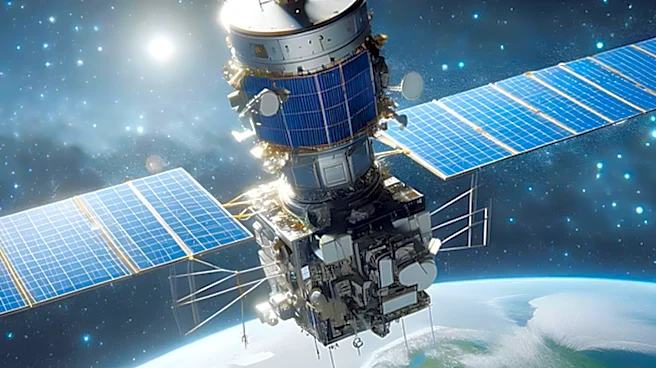
Amazon's Project Kuiper satellite, KUIPER-00200 (NORAD 67772, COSPAR 2026-030J), launched on an Ariane 64 in February 2026, has successfully maintained its orbital slot within 74 meters over 88 days of tracking. The satellite, part of Amazon's low Earth
orbit broadband constellation, is operating in a near-circular orbit at approximately 635 km altitude with a 51.9-degree inclination. This precise station-keeping indicates that the satellite is actively performing routine burns to counteract atmospheric drag and hold its designated position. KUIPER-00200 is one of the satellites deployed as part of Amazon's strategy to populate its constellation, utilizing various launch providers, including Arianespace's Ariane 64, the four-booster version of the Ariane 6.
Why It's Important?
The ability of KUIPER-00200 to maintain such precise orbital positioning is crucial for the functionality and efficiency of Amazon's Project Kuiper broadband constellation. Stable orbital slots ensure optimal signal coverage, minimize interference between satellites, and contribute to the overall reliability of the internet service. This precision demonstrates the advanced capabilities of Amazon's satellite bus technology and its operational control systems. For the U.S. and global broadband market, the successful deployment and operation of these satellites are vital for expanding internet access, particularly in underserved areas, and for fostering competition in the satellite internet sector. The consistent performance of individual satellites like KUIPER-00200 is a key indicator of the overall health and future success of the entire constellation, which aims to compete directly with services like SpaceX's Starlink.
What's Next?
As Amazon continues to deploy more satellites for Project Kuiper, the consistent performance demonstrated by KUIPER-00200 will be critical for scaling the constellation. The ongoing operational stability of these satellites will allow Amazon to proceed with its plans for an initial rollout of commercial internet service. Future launches, including those booked on Ariane 6, Blue Origin's New Glenn, and SpaceX's Falcon 9, will continue to populate the constellation towards its goal of 3,232 first-generation satellites. The data gathered from satellites like KUIPER-00200 will inform operational strategies, refine station-keeping procedures, and potentially influence the design of future generations of Kuiper satellites. The success of these individual satellites is a foundational element for Amazon to meet its regulatory obligations and achieve its long-term business objectives in the competitive satellite broadband market.
Beyond the Headlines
The precise orbital maintenance of KUIPER-00200 highlights the increasing sophistication of satellite technology and orbital mechanics in the commercial space sector. This level of precision is not only a technical achievement but also has broader implications for space traffic management and the sustainability of low Earth orbit. As more constellations are deployed, the ability of individual satellites to maintain their designated positions accurately becomes paramount to prevent collisions and manage orbital debris. Amazon's success in this area contributes to the overall understanding and best practices for operating large satellite constellations. Furthermore, the use of a European launch vehicle like Ariane 64 by a U.S. company like Amazon underscores the globalized nature of the space industry, where companies leverage international partnerships to achieve their strategic goals, fostering a more interconnected and competitive space economy.