






What's Happening?
During New York Climate Week, a recurring question in fashion discussions was whether a compelling business case exists for sustainability. Industry leaders and experts noted that while consumers express willingness to pay more for sustainably produced
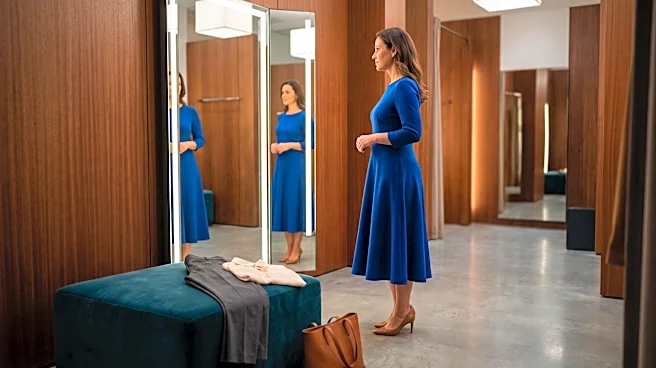
garments, this sentiment rarely translates into actual purchasing behavior at scale. Kate Sanner, founder and CEO of resale-shopping app Beni, described sustainability as a 'gift with purchase' that makes people feel good, rather than the primary motivator for buying clothes. Garrett Wilson, co-founder of Ryker Clothing Co., emphasized that people buy clothes because they 'look good,' not primarily to 'save the ocean.' This suggests a disconnect between consumer values and purchasing decisions, making it challenging for sustainable innovations to gain widespread commercial viability.
Why It's Important?
This debate is crucial because it highlights a significant barrier to the widespread adoption of sustainable practices in the fashion industry. If the financial incentives for sustainability are not clear or strong enough, businesses will struggle to justify the necessary investments in eco-friendly materials, processes, and supply chains. The current situation, where the 'moral case' for sustainability often fails to convince CFOs, means that many promising innovations remain stuck in the 'Valley of Death'—unable to scale due to lack of funding and commercial viability. This consumer apathy, coupled with the industry's reliance on growth and volume, perpetuates environmentally damaging practices and slows the transition to a circular economy, impacting global greenhouse gas emissions and resource depletion.
What's Next?
To address this challenge, sustainability advocates are increasingly framing their arguments in terms of growth, resilience, and returns, aiming to persuade finance chiefs that sustainability is a financial-management issue. Proposals include policy mechanisms like California's SB 707, the Responsible Textile Recovery Act, which would introduce eco-modulated fees to reward sustainable practices and penalize unsustainable ones. Efforts are also underway to aggregate demand for next-generation materials to create economies of scale and drive down costs, as seen with Circ's Fiber Club. Brands like Dôen and Cotopaxi are integrating circularity into their business models, seeing resale and repair as revenue channels and loyalty programs. The focus is on making sustainable options more appealing and valuable to consumers, rather than relying solely on ethical appeals, and on demonstrating the long-term financial benefits of sustainable practices, such as cost avoidance and revenue protection.
Beyond the Headlines
The struggle to make a compelling business case for sustainability in fashion reveals a deeper societal issue: the gap between stated values and actual behavior. While many consumers express concern for the environment, their purchasing decisions are often driven by aesthetics, price, and convenience. This creates an ethical dilemma for brands and policymakers, who must navigate how to incentivize sustainable choices without alienating consumers or undermining profitability. The discussion also touches on the 'woke culture' backlash, which can make companies reluctant to publicly champion sustainability, even if they are working on it internally. Ultimately, the path forward may involve a combination of smart regulation, innovative business models that integrate sustainability as a core value proposition, and a cultural shift that elevates the perceived value of sustainable products beyond mere ethical considerations, making them desirable for their quality, design, and long-term benefits.