






What's Happening?
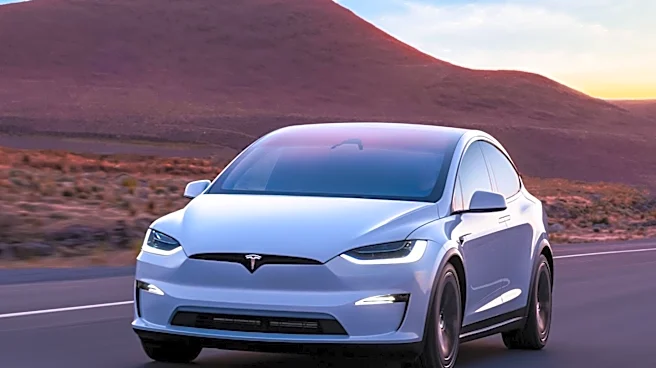
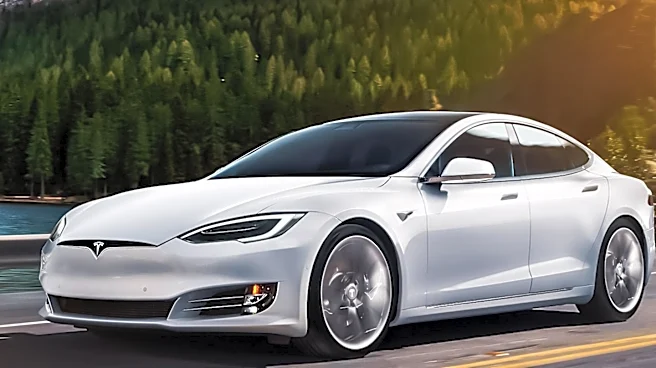
Paul Graham, co-founder of Y Combinator, highlighted the substantial improvements in Tesla vehicle range and affordability over the past decade. He cited his wife, Jessica Livingston's, recent purchase of a Tesla for $48,000, which boasts a range of approximately
350 miles. This contrasts sharply with a Tesla Livingston bought in 2015, which cost the equivalent of $135,000 in today's dollars and offered a range of 270 miles. Graham shared this observation on X, to which Elon Musk responded with 'True.' While Graham did not specify the new model, Tesla's inventory includes a 2026 Model Y Premium Rear-Wheel Drive priced at $45,990 with an EPA-estimated 357-mile range. This model's U.S. price increased by $1,000 in May, with the Premium All-Wheel Drive rising to $49,990.
Why It's Important?
This comparison underscores Tesla's evolution from a niche, premium-only manufacturer to a company offering more accessible and capable electric vehicles. The significant reduction in price for increased range reflects advancements in manufacturing scale and a substantial decrease in battery costs. The U.S. Department of Energy estimates that lithium-ion battery-pack costs for light-duty EVs plummeted by 90% from 2008 to 2023, from $1,415 per kilowatt-hour to $139 in constant 2023 dollars, attributed to better chemistries, technology, and manufacturing scale. The International Energy Agency further reported an 8% drop in average battery prices in 2025, contributing to a nearly 2% slip in the average U.S. battery-electric vehicle retail price. This trend is crucial for the broader adoption of electric vehicles, making them more competitive with internal-combustion cars and potentially accelerating the transition to sustainable transportation.
What's Next?
The continued decline in battery costs and increased manufacturing efficiency are expected to further enhance the affordability and performance of electric vehicles. Tesla, along with other automakers, will likely continue to introduce lower-priced EV variants to broaden market appeal, as seen with Tesla's Model 3 and Model Y variants in 2025. However, EV affordability remains uneven nationwide, with fewer than 20% of U.S. electric models in 2024 and 2025 having base prices below the median cost of an internal-combustion car. Future developments will likely focus on closing this affordability gap, potentially through government incentives, further technological breakthroughs, and increased competition among EV manufacturers. The ongoing efforts to make EVs more accessible will be critical for meeting climate goals and transforming the automotive industry.
Beyond the Headlines
The trend of increasing affordability and performance in electric vehicles, as highlighted by Paul Graham, has profound implications beyond individual consumer savings. It signifies a broader shift in the automotive industry and energy sector, driven by technological innovation and economies of scale. This development challenges the perception that electric vehicles are exclusively luxury items, making them a more viable option for a wider demographic. The reduction in battery costs, in particular, is a game-changer, impacting not only EVs but also grid-scale energy storage solutions, which are vital for integrating renewable energy sources. This shift could lead to a more resilient and sustainable energy infrastructure, reducing reliance on fossil fuels and mitigating climate change. The competitive landscape among EV manufacturers is also intensifying, pushing innovation and further driving down costs, ultimately benefiting consumers and the environment.