







What's Happening?
GlobalFoundries (GF) and SMART Photonics have introduced the first open-access foundry for integrated photonics, combining silicon and indium phosphide (InP) technologies. This collaboration aims to integrate active components, such as lasers and modulators,
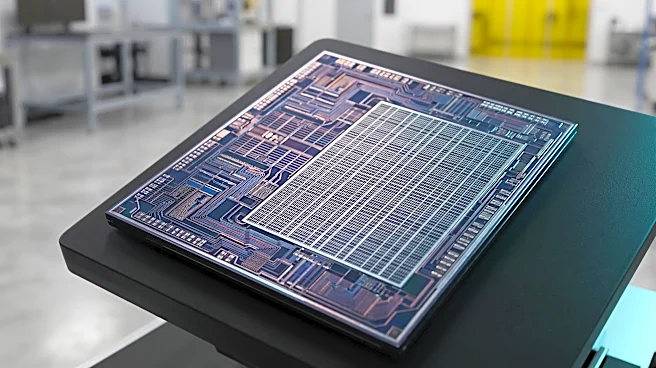
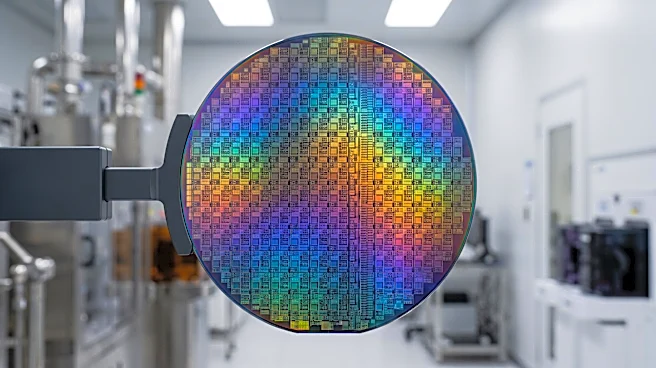
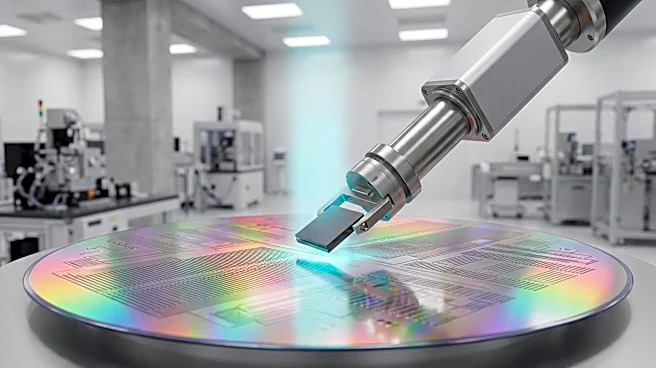
directly into silicon chips. The new service is designed to support applications in AI data centers, optical transceivers, and LiDAR systems, with the goal of reducing production costs and accelerating time to market. The foundry service merges GF’s scalable silicon photonics platform with SMART Photonics’ InP-based photonic integrated circuits (PICs). Indium phosphide is crucial for active components like lasers and amplifiers, while silicon is adept at passive optical routing and processing. GF provides a silicon-based cavity where SMART Photonics integrates its lasers and semiconductor optical amplifiers (SOAs) using flip-chip technology, thereby streamlining the design cycle for customers. The companies have spent over a year addressing technical challenges, including dimensional compatibility and efficient optical coupling, and have developed manufacturing innovations to reduce chiplet size and cost while maintaining performance.
Why It's Important?
This joint venture is significant for the U.S. technology sector, particularly in the context of increasing demand for high-bandwidth and low-latency solutions in AI data centers. By combining InP laser sources with silicon photonics, the collaboration enables the creation of more compact and efficient optical transceivers, which are critical for advanced optical links such as 800G and 1.6T. This innovation addresses scalability challenges in AI data centers and could lead to substantial improvements in performance and cost efficiency for optical products. The initiative also strengthens the position of U.S.-based GlobalFoundries in the global semiconductor and photonics industries, offering a unique foundry service that could reduce reliance on foreign supply chains for critical components. The market for InP circuits is experiencing significant annual growth, driven by telecommunications, data centers, and LiDAR applications, making this development strategically important for companies operating in these sectors.
What's Next?
The joint foundry service is anticipated to become available in the second half of 2027. Leading up to this launch, both GlobalFoundries and SMART Photonics will focus on process qualification, the development of design tools, and packaging solutions. The service is expected to cater to a broad range of applications, including AI, data centers, LiDAR, and medical equipment. GF has emphasized that its silicon photonics platform is compatible with various form factors, such as pluggable optical transceivers and co-packaged optics (CPO), which will facilitate the development of next-generation optical products with enhanced performance and reduced costs. This collaboration is poised to influence future developments in integrated photonics, potentially setting new industry standards for efficiency and integration in high-demand technological fields.
Beyond the Headlines
This partnership between GlobalFoundries and SMART Photonics represents a deeper strategic move towards enhancing domestic capabilities in advanced semiconductor manufacturing and integrated photonics. By offering an open-access foundry, the initiative aims to lower barriers to innovation for companies, particularly in regions seeking to bolster their technological independence. The integration of silicon and indium phosphide on a single platform is a complex engineering feat that could accelerate the development of novel applications beyond current capabilities, potentially impacting areas like quantum computing and advanced sensing. The focus on energy-efficient photonics also aligns with broader environmental sustainability goals, as data centers consume significant amounts of energy. This development could foster a more resilient and diversified supply chain for critical components, reducing geopolitical risks associated with concentrated manufacturing in specific regions.