






What's Happening?
Bechtel, the lead engineering and construction contractor for TerraPower's Natrium nuclear power plant project near Kemmerer, Wyoming, has announced its withdrawal from the project. This decision will result in the elimination of 200 positions at Bechtel's
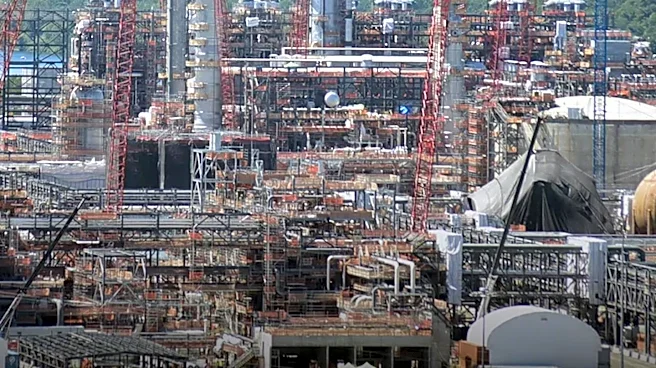
nuclear engineering headquarters in Reston, Virginia, starting in November. TerraPower, backed by Bill Gates, selected Kemmerer in 2021 for its pilot Natrium plant, which features a liquid-sodium cooled 'advanced' nuclear reactor. Despite Bechtel's departure, TerraPower states that construction will continue as planned, with the company rebidding the Engineering, Procurement, and Construction (EPC) contract. Bechtel and TerraPower were unable to reach an agreement on the next phase of the project, leading to their decision to move forward separately. Bechtel will complete its work on a 'sodium test-and-fill facility,' and bidding is underway to find a replacement firm. Construction on non-nuclear portions of the project began in 2024 and 2025, and the U.S. Nuclear Regulatory Commission (NRC) issued a construction permit for the nuclear portions in March, marking the first commercial reactor approval in nearly a decade in the U.S.
Why It's Important?
This development highlights potential challenges in the deployment of advanced nuclear reactor technology, even for projects with significant backing and government support. The Natrium plant, a $4 billion project supported by $2 billion from the Department of Energy, is intended to be a critical step in addressing climate change and growing electricity demand. The departure of a major contractor like Bechtel could introduce delays or increased costs, impacting the project's timeline and budget. While TerraPower asserts that the construction schedule will be maintained, the need to rebid a significant contract can be a complex process. This situation also underscores the evolving landscape of nuclear energy development, where new designs and construction methodologies are being implemented. The project's success is crucial for demonstrating the viability of advanced nuclear reactors and could influence future investments and regulatory approvals for similar initiatives across the U.S. and internationally.
What's Next?
TerraPower will proceed with rebidding the Engineering, Procurement, and Construction (EPC) contract to find a new lead contractor for the Natrium nuclear power plant project. Bechtel will finalize its work on the 'sodium test-and-fill facility.' The project's non-nuclear construction will continue, and TerraPower aims to secure an operating license from the U.S. Nuclear Regulatory Commission (NRC) by 2028, with full operational status anticipated by 2031. The company plans to build similar Natrium-design nuclear power plants in the U.S. and other countries, making the successful continuation of this pilot project critical for its broader expansion strategy. Stakeholders, including the Department of Energy and local communities, will closely monitor the transition to a new contractor and any potential impacts on the project's schedule and budget.
Beyond the Headlines
The exit of Bechtel from the Natrium project, despite its advanced stage and significant investment, points to deeper complexities within the nuclear energy sector, particularly concerning novel reactor designs. It raises questions about the contractual frameworks and risk-sharing models between developers and large engineering firms for first-of-a-kind projects. The incident could influence how future advanced nuclear projects are structured, potentially leading to more detailed upfront agreements or alternative contracting strategies to mitigate such disruptions. Furthermore, the need to rebid a major contract could inadvertently provide an opportunity for other firms to enter the advanced nuclear construction space, fostering competition and potentially accelerating innovation in project delivery. The situation also subtly highlights the ongoing challenge of workforce development in the nuclear industry, as Bechtel's employees will be reassigned to other nuclear projects, indicating a demand for specialized skills across the sector.