






What's Happening?
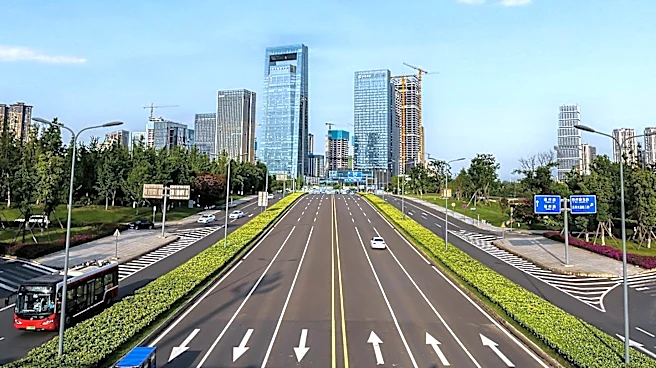
Shenzhen, China, has undergone a significant transformation from a small border town into a global innovation hub over the past four decades, offering insights into Asia-Pacific regional integration and trade connectivity. This development is closely
linked to the Asia-Pacific Economic Cooperation (APEC), which Shenzhen will host for the Economic Leaders' Meeting. According to Shenzhen Customs data, the city's imports and exports with APEC economies surged from 267.5 billion yuan ($39.81 billion) in 1996 to 3.13 trillion yuan in 2025, reflecting an average annual growth rate of 8.5 percent. In 2025, advanced products like electric vehicles, lithium-ion batteries, photovoltaic products, AI-powered goods, and medical instruments constituted 25.6 percent of Shenzhen's exports to APEC members. The city's openness has attracted significant foreign investment, with companies from 180 countries and regions, including over 340 Fortune Global 500 companies, investing there. In 2025, foreign-funded enterprises from Asia-Pacific economies accounted for 93.3 percent of new establishments in Shenzhen.
Why It's Important?
Shenzhen's rapid economic growth and integration within the Asia-Pacific region present both opportunities and challenges for U.S. businesses. The city's role as an innovation hub, particularly in high-tech sectors like AI, robotics, and semiconductors, indicates a dynamic market for collaboration and competition. U.S. companies can leverage Shenzhen's advanced manufacturing capabilities and access to a vast consumer base within the APEC framework. However, they must also contend with increasing competition from local innovators and a regulatory environment that prioritizes regional integration. The significant foreign investment from Asia-Pacific economies into Shenzhen highlights the region's growing economic self-reliance and interconnectedness, which U.S. firms need to understand to formulate effective market entry and partnership strategies. The emphasis on free trade and open cooperation within APEC, as exemplified by Shenzhen, suggests a continued push for reduced trade barriers that could benefit U.S. exporters.
What's Next?
As Shenzhen hosts the APEC Economic Leaders' Meeting, there will likely be further discussions and initiatives aimed at promoting regional free trade and economic cooperation. U.S. businesses should monitor these developments for potential changes in trade policies, tariff structures, and investment opportunities within the Asia-Pacific. The continued focus on innovation and high-value-added industries in Shenzhen suggests that future collaborations will increasingly involve advanced technologies and R&D. Companies like ComfortDelGro Group establishing autonomous driving headquarters in Shenzhen indicate a trend towards developing replicable operating models that can be scaled across the region, offering potential blueprints for U.S. firms. The ongoing integration of industrial and supply chains, as seen with Keyto's investment in Malaysia, points to a more resilient and interconnected regional economy that U.S. businesses will need to navigate strategically.
Beyond the Headlines
Shenzhen's evolution reflects a broader shift in global economic power and innovation, with the Asia-Pacific region increasingly becoming a center for technological advancement and industrial integration. For the U.S., this signifies a need to re-evaluate its engagement strategies in the region, moving beyond traditional trade relationships to embrace more complex innovation partnerships. The 'new trio' of exported products from Shenzhen—electric vehicles, lithium-ion batteries, and photovoltaic products—underscores China's growing leadership in green technologies, an area where U.S. companies face both competition and opportunities for collaboration. The story of Shenzhen also highlights the importance of open economic policies and foreign investment in fostering rapid development, offering lessons for other emerging economies. The city's success in attracting foreign capital, particularly from within the Asia-Pacific, suggests a deepening regional economic bloc that could reshape global trade dynamics.