




What's Happening?
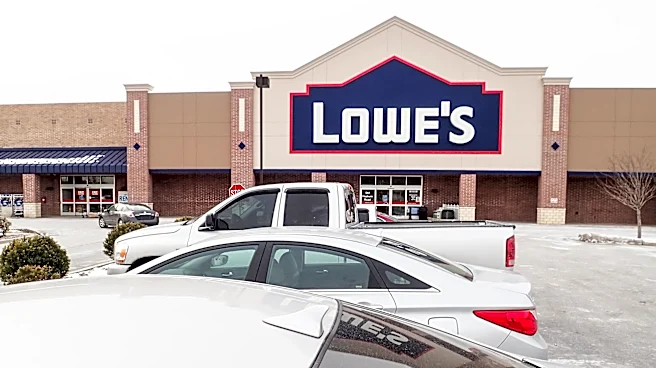
Lowe's India, initially established in 2014 with 11 associates in Bengaluru, has evolved from a cost-saving center to a significant capability hub under the leadership of CEO Marvin Ellison. According to Seemantini Godbole, Lowe's Chief Digital and Information
Officer, Ellison's arrival marked a strategic shift, aiming to empower every associate and integrate the India center into this broader vision. The center, which now employs over 5,000 associates, has expanded its mandate beyond back-office support to include critical business and technology functions. This transformation involves developing platforms like AI Foundry, an AI platform that routes queries to optimized models, and contributing to tools for 300,000 store associates, such as Mylow Companion. Additionally, the India teams are involved in supply chain simulation, merchandising, marketing, finance, and product management, demonstrating a move towards ownership and innovation rather than just execution.
Why It's Important?
This strategic transformation of Lowe's India center signifies a broader trend in how U.S. multinational corporations are leveraging global capabilities. By shifting from a cost-centric model to an innovation and ownership-driven hub, Lowe's is enhancing its operational efficiency and technological prowess. This approach allows the company to develop advanced AI platforms and associate tools, which can significantly improve customer service and in-store operations across its 1,750 U.S. stores. The integration of business and technology teams in India enables faster problem-solving and decision-making, potentially leading to more agile responses to market demands and competitive advantages in the home improvement sector. This model also highlights the increasing importance of global talent pools in driving technological innovation and strategic growth for U.S. companies, impacting their overall market position and profitability.
What's Next?
The success of Lowe's India as a capability hub is expected to influence how other U.S. companies approach their global centers, potentially accelerating the shift from mere support functions to strategic innovation and ownership. Companies establishing or managing Global Capability Centers (GCCs) may increasingly adopt Lowe's playbook, focusing on granting decision rights, building platforms, integrating business and technology teams, and investing in leadership development. This could lead to a more distributed and empowered global workforce, fostering innovation and efficiency across various industries. For Lowe's, continued investment in its India center is likely, with further expansion of its capabilities and integration into core business strategies, potentially leading to more advanced technological solutions and improved operational outcomes.
Beyond the Headlines
The evolution of Lowe's India center reflects a fundamental re-evaluation of global talent and resource allocation within large corporations. This shift challenges the traditional perception of offshore centers as purely cost-saving measures, instead positioning them as integral components of a company's innovation ecosystem. The emphasis on 'ownership' rather than 'execution' suggests a deeper integration of diverse cultural and intellectual capital into corporate strategy. This model could lead to a more resilient and adaptable global business landscape, where innovation is not confined to headquarters but is a distributed and collaborative effort. It also raises questions about the future of work, the nature of global collaboration, and the ethical implications of leveraging diverse talent pools for strategic advantage.