





What's Happening?
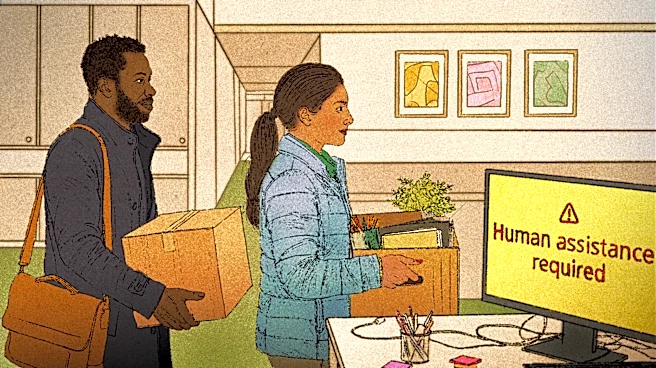
A 2026 study by talent intelligence company SHL has identified a new workplace phenomenon termed 'AI rebounding,' where employees initially replaced by artificial intelligence are later asked to return by the same employer. The research, based on an online
survey of 2,036 employed adults across the United States and the United Kingdom, found that 52% of respondents had encountered AI rebounding either personally, through acquaintances, or by hearing about it. Specifically, 19% of U.S. respondents reported firsthand experience. This trend is particularly noticeable among younger workers, with 24% of those aged 18 to 24 personally experiencing AI rebounding. The study suggests that employers may be automating roles without fully understanding the comprehensive capabilities and contributions of their human workforce, leading to operational gaps that AI alone cannot fill. When asked to return, these employees often demand better terms, including substantial pay increases, job security guarantees, and transparency regarding AI's future role in their positions.
Why It's Important?
The 'AI rebounding' trend highlights a critical disconnect in how U.S. businesses are approaching AI integration and workforce planning. Employers risk significant financial and operational costs by prematurely replacing human workers with AI, only to discover that essential skills, contextual knowledge, and problem-solving abilities are lost. This cycle of replacement and rehiring can erode employee trust, increase compensation demands, and create instability within organizations. The study indicates that many employers lack a comprehensive understanding of their workforce's skills beyond formal job descriptions, with only 42% of respondents believing their managers fully grasp their capabilities. This oversight can lead to inefficient automation decisions and a failure to leverage existing talent through reskilling or internal mobility, ultimately impacting productivity and competitiveness in the evolving U.S. labor market.
What's Next?
As AI adoption continues to accelerate, U.S. employers will likely face increasing pressure to refine their workforce planning strategies to avoid the pitfalls of 'AI rebounding.' This will necessitate a more thorough assessment of human capabilities, including transferable skills and institutional knowledge, before making automation decisions. HR departments are expected to play a more central role in these discussions, focusing on talent assessments, skills inventories, and internal mobility programs to identify employees who can transition into new roles or work alongside AI. Technology providers in the HR space will see increased demand for platforms that offer skills intelligence, talent assessment, and workforce planning tools to help organizations understand their capabilities beyond job titles. Employers who fail to adapt may continue to incur costs associated with rehiring and retraining, while also struggling with employee retention and trust.
Beyond the Headlines
The 'AI rebounding' phenomenon points to deeper ethical and strategic implications for the future of work in the U.S. It underscores the challenge of distinguishing between automating tasks and eliminating entire roles, revealing that many jobs encompass complex human elements like judgment, collaboration, and relationship-building that AI cannot easily replicate. The trend also raises questions about the long-term impact on career development, particularly for younger workers whose entry-level roles, often targeted for automation, are crucial for developing foundational skills and institutional knowledge. A failure to adequately consider these aspects could lead to a weakened future talent pipeline and a less resilient workforce. Ultimately, this trend calls for a more human-centric approach to AI integration, where technology augments rather than simply replaces human capabilities, fostering a more sustainable and equitable evolution of the U.S. labor market.