






What's Happening?
Doroni Aerospace has announced a partnership with Seattle-based TLG Aerospace to advance the engineering analysis and certification efforts for its H1-X personal electric vertical takeoff and landing (eVTOL) aircraft. This collaboration will focus on critical
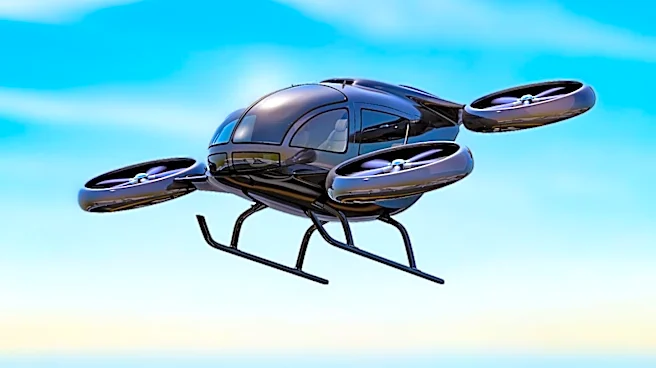
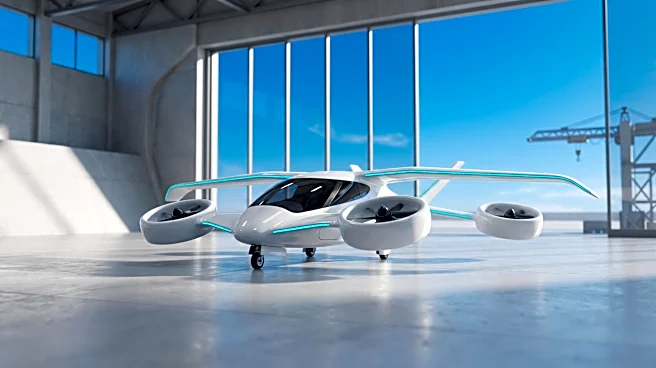
aspects of the H1-X's development, including vehicle design, structural loads analysis, finite element analysis (FEA), computational fluid dynamics (CFD), and flight mechanics. The primary goal of this work is to support the aircraft's progression towards full-scale production, ground testing, and meeting FAA airworthiness requirements. The H1-X is designed as a personal eVTOL with a tandem-wing configuration and enclosed ducted-fan propulsion, intended for residential garage storage and personal flight operations. Doroni is also developing a digital co-pilot system for the aircraft. TLG Aerospace will provide engineering and certification support from its Seattle operations, leveraging its expertise in aircraft programs from early-stage development through flight certification.
Why It's Important?
This partnership is a significant step for Doroni Aerospace in bringing its H1-X eVTOL to market, highlighting the complex and rigorous process of aircraft development and certification in the U.S. The involvement of TLG Aerospace, with its FAA Designated Engineering Representatives, is crucial for navigating the regulatory landscape, particularly under the FAA's MOSAIC framework. The focus on structural and aerodynamic analysis before physical construction and testing aims to ensure the safety and performance of the carbon-fiber structure and flight characteristics. Successful certification of personal eVTOLs like the H1-X could revolutionize urban and regional transportation, offering new options for personal mobility and potentially alleviating traffic congestion. It also signifies the growing maturity of the eVTOL industry, moving from conceptual designs to practical, certifiable aircraft, which could attract further investment and accelerate the adoption of advanced air mobility solutions in the United States.
What's Next?
The collaboration between Doroni Aerospace and TLG Aerospace will continue with the preparation of engineering datasets, stress reports, and test plans, all intended to align with applicable consensus standards under the MOSAIC framework. This will pave the way for advanced flight testing and production development of the H1-X. The companies will conduct extensive structural and aerodynamic analyses to assess the aircraft's performance across different flight regimes, including hover and forward flight, and evaluate transition characteristics and energy consumption. The ultimate goal is to achieve FAA airworthiness certification, which is essential for the H1-X to move into full-scale production and commercial deployment. The success of this certification process will be a key indicator for the future of personal eVTOLs in the U.S. market, potentially influencing regulatory approaches and market acceptance for similar aircraft.
Beyond the Headlines
The development of personal eVTOLs like the H1-X raises broader questions about urban planning, infrastructure, and societal integration. While designed for personal use, widespread adoption would necessitate new regulations for airspace management, noise control, and landing infrastructure (vertiports). The concept of 'residential garage storage' for an aircraft, while appealing, implies a significant shift in how individuals interact with transportation and their immediate environment. Furthermore, the integration of a 'digital co-pilot system' points to the increasing role of artificial intelligence and automation in aviation, which will require robust cybersecurity measures and public trust. The success of such ventures will not only depend on technological feasibility and regulatory approval but also on public acceptance and the ability of urban environments to adapt to this new mode of transport, potentially leading to new forms of urbanism and community design.