







What's Happening?
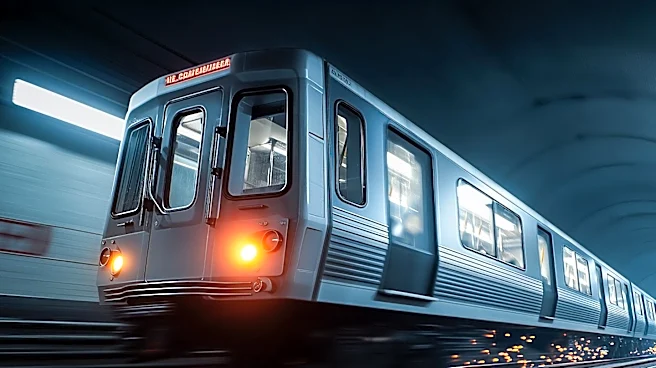
Bong Joon-ho's film 'Snowpiercer' is highlighted as a significant work exploring dystopian societies and the consequences of unchecked power. The movie depicts a post-apocalyptic world where humanity survives on a perpetually moving train. Within this
train, a stark class system exists: the wealthy reside in luxury at the front, while those in the tail section endure extreme poverty and brutal conditions. The narrative follows Curtis, played by Chris Evans, as he leads a rebellion against this oppressive system. Tilda Swinton portrays Mason, an official dedicated to maintaining the established order, and Octavia Spencer joins the rebellion as Tanya. The film visually contrasts the opulent front carriages with the squalid conditions in the rear, emphasizing the severe inequality that underpins the train's society. This exploration of social stratification and rebellion makes 'Snowpiercer' a relevant piece for discussions on societal structures and power dynamics.
Why It's Important?
'Snowpiercer' is important because it serves as a powerful allegory for real-world social and economic inequalities. The film's depiction of a rigid class system, where a privileged few enjoy abundance while the majority suffer deprivation, resonates with contemporary discussions about wealth disparity and social justice. The rebellion led by Curtis symbolizes the struggle against oppressive systems and the fight for basic human rights and dignity. The film prompts viewers to consider the ethical implications of extreme social stratification and the potential for societal collapse when such disparities are left unaddressed. Its themes of survival, class warfare, and the corrupting influence of power offer a critical lens through which to examine societal structures and the human condition, making it a culturally significant work that encourages reflection on current global challenges.
What's Next?
While 'Snowpiercer' itself is a completed film, its themes continue to be relevant and explored in various media. The film has already inspired a television series, which further delves into the complex social dynamics and survival challenges aboard the train. This ongoing adaptation suggests a continued interest in the narrative's core ideas about class struggle and societal resilience. Future discussions and analyses of 'Snowpiercer' are likely to focus on its enduring relevance in an increasingly polarized world, especially as conversations around economic inequality and social justice persist. The film's influence may also be seen in future dystopian narratives that tackle similar themes of power, control, and rebellion, solidifying its place as a significant work in the genre.
Beyond the Headlines
Beyond its immediate narrative, 'Snowpiercer' delves into profound ethical and philosophical questions about human nature and societal organization. The film implicitly critiques capitalist systems and the inherent injustices that can arise from unchecked power and resource hoarding. It explores the psychological impact of extreme deprivation and privilege on individuals and groups, highlighting how such conditions can shape morality and drive conflict. The train itself can be seen as a microcosm of global society, where resources are finite and their distribution is dictated by an elite few. This raises questions about sustainability, governance, and the potential for revolution when systemic inequalities become unbearable. The film's stark visual contrasts and character arcs invite deeper contemplation on the responsibilities of those in power and the universal human desire for freedom and equality.