







What's Happening?
Marathon Petroleum Corporation (MPC) has made a minority investment in Capwell, a Houston, Texas-based methane capture technology company. This investment aims to strengthen the relationship between the two companies and support the deployment of Capwell's
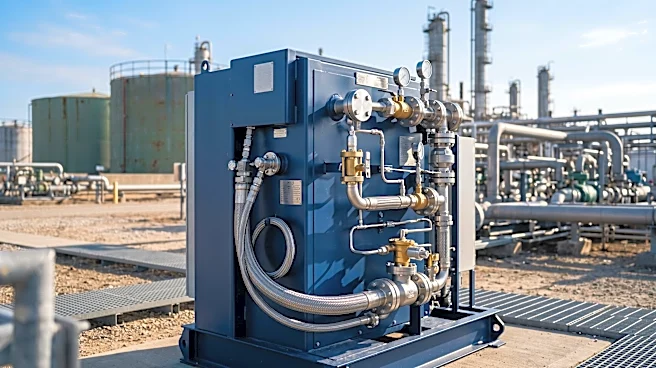
low-flow vapor recovery solutions across the oil and gas value chain. The partnership will enable Capwell to work with MPC and MPLX GP LLC to implement its technology, which is designed to reduce emissions while simultaneously creating new revenue opportunities. Capwell's solutions specifically target low-flow and intermittent vent sources, such as tank batteries, compressor rod packing vents, pneumatic valves and pumps, and glycol dehydrators, which are typically challenging and uneconomical to address with conventional vapor recovery equipment.
Why It's Important?
This strategic investment is important for several reasons. For Marathon Petroleum, it signifies a commitment to reducing emissions and improving environmental performance within its operations, aligning with growing industry and regulatory pressures for sustainability. By deploying Capwell's technology, MPC can enhance its operational efficiency by capturing previously vented gases, which can then be sold or utilized, turning a waste product into a revenue stream. For Capwell, the investment provides crucial capital and access to MPC's extensive resources and industry expertise, accelerating the adoption and scaling of its innovative methane capture solutions. This collaboration could set a precedent for how large energy companies integrate advanced environmental technologies to meet both economic and ecological objectives.
What's Next?
The partnership between Marathon Petroleum and Capwell is expected to lead to the deployment of Capwell's low-flow vapor recovery technology across MPC's and MPLX's operations. This will involve integrating Capwell's compact systems into various parts of the oil and gas infrastructure, focusing on sources that are difficult to manage with existing methods. The success of these deployments will be closely watched as a model for broader industry adoption. Future developments may include further investments, expanded partnerships, and the development of new technologies aimed at continuous improvement in emission reduction and operational efficiency within the energy sector. The collaboration also highlights a trend towards technological solutions for environmental challenges in the oil and gas industry.
Beyond the Headlines
This investment goes beyond a simple business transaction; it represents a significant step in addressing methane emissions, a potent greenhouse gas, from the oil and gas industry. By focusing on low-flow and intermittent sources, which are often overlooked, the partnership tackles a critical aspect of environmental impact that conventional methods struggle with. This initiative could influence industry best practices, encouraging other energy companies to invest in similar innovative solutions. It also underscores the evolving role of technology in enabling the energy sector to meet environmental targets while maintaining economic viability, potentially leading to a more sustainable and responsible approach to energy production in the long term.