



What's Happening?
Relativity Networks has announced $22 million in SAFE note funding from investors including Rhapsody Venture Partners, Bell Ventures Inc., and Faster Than Glass LLC. Concurrently, the company secured a $40 million follow-on order from a leading hyperscaler,
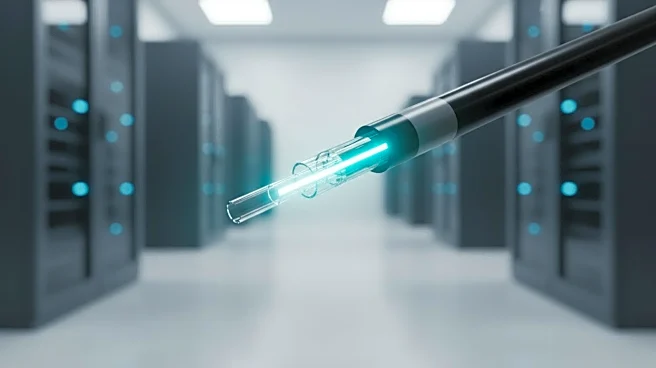
which remains unnamed. Relativity Networks specializes in hollow-core fiber technology, which transmits data 30% faster than traditional fiber by using a vacuum chamber instead of glass. This innovation reduces signal travel time significantly, from approximately five microseconds per kilometer in conventional fiber to three and a half microseconds in hollow-core fiber. The company aims to address the growing latency challenges in large-scale data center operations, particularly as AI compute infrastructure expands across vast geographical areas.
Why It's Important?
This development is crucial for the data center industry, which is projected to spend $4 trillion by the end of the decade and faces significant constraints in terms of location and power grids. The enhanced speed offered by hollow-core fiber could fundamentally alter the geographical considerations for data center development. By reducing latency, Relativity Networks' technology allows data centers to span larger distances while maintaining efficient operation, effectively alleviating some of the spatial limitations currently impacting the industry. This is particularly vital for AI compute, where physical distances between GPUs have grown, making latency a more critical factor. The investment and significant order indicate strong market confidence in the potential of this technology to optimize data center performance and expand their operational footprint.
What's Next?
With the new funding and a substantial order, Relativity Networks is poised to accelerate the deployment and adoption of its hollow-core fiber technology. The company's CEO, Jason Eisenholz, anticipates that this technology will usher in a 'third era' of AI optimization, focusing on geography after initial eras concentrated on compute and in-data center networking. This suggests a future where multi-campus data center deployments can operate more cohesively as single units, leveraging existing infrastructure more effectively. The $40 million follow-on order from a major hyperscaler indicates that large industry players are already recognizing the value and potential of this faster fiber. Future developments will likely include further expansion of their client base and continued innovation in fiber optics to meet the escalating demands of AI and other data-intensive applications.
Beyond the Headlines
The advancement in fiber optic technology by Relativity Networks has deeper implications beyond just faster data transmission. It represents a significant step towards overcoming physical limitations in the digital infrastructure that underpins modern technology, especially artificial intelligence. The ability to reduce latency by 30% could unlock new possibilities for real-time data processing and distributed computing, which are critical for the next generation of AI applications. This could lead to more efficient use of energy and resources in data centers, as the need for ultra-close proximity might be lessened. Furthermore, it highlights the continuous innovation required in foundational technologies to keep pace with the rapid evolution of AI and other demanding computational fields, potentially influencing urban planning and infrastructure development around data center hubs.