



What's Happening?
New York Times columnist Ezra Klein, on the 'Hard Fork' podcast, suggested the potential 'end of Oracle' as OpenAI reconsiders its data center capacity plans following the recent midterm elections. According to The Wall Street Journal, senior leaders
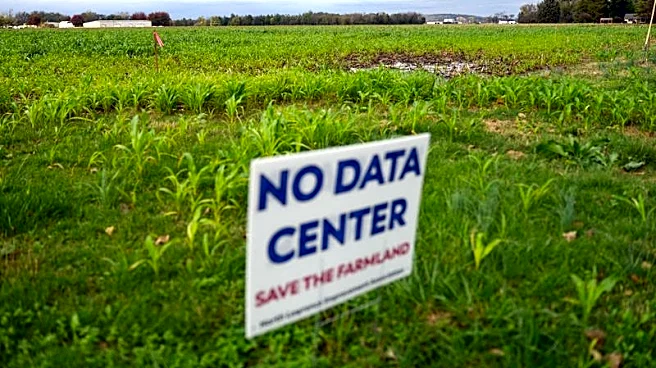
at OpenAI discussed resetting next year's data center capacity expectations. This reassessment comes after Goldman Sachs warned that Democratic victories at state and local levels could jeopardize 45% of planned U.S. data center capacity. Oracle is particularly exposed to any slowdown in OpenAI's build-out, as S&P indicates that OpenAI accounts for approximately half of Oracle's substantial $664 billion backlog. Oracle's capital expenditures have significantly increased, reaching $55.7 billion in fiscal 2026, and its total debt has climbed to $167 billion. Analysts anticipate negative free cash flow for Oracle through fiscal 2028. The company's financial situation is further highlighted by an anonymous seller auctioning about $500 million in data center loans, including one tied to Oracle's Stargate site in New Mexico, with bids due November 19.
Why It's Important?
This development is significant for the U.S. technology and financial sectors, particularly for companies heavily invested in AI infrastructure. A potential slowdown in OpenAI's data center expansion directly impacts Oracle, its primary infrastructure provider, raising concerns about Oracle's financial stability given its substantial debt and reliance on OpenAI's projects. The broader implication is a potential re-evaluation of the rapid expansion in AI-related capital expenditures across the industry. If political shifts lead to reduced data center development, it could temper the current AI investment boom, affecting stock market valuations and economic growth driven by AI. For investors, this situation underscores the risks associated with concentrated customer bases and high capital expenditure strategies, especially when political outcomes can influence large-scale infrastructure projects. The auction of data center loans also signals potential distress in the market for financing these massive projects, which could lead to tighter lending conditions for future AI infrastructure development.
What's Next?
OpenAI's final decision on its data center capacity plans will be crucial for Oracle and the broader AI infrastructure market. While no contracts have been officially altered yet, Oracle's second-quarter results in mid-December will provide insight into whether its backlog remains stable. The outcome of the data center loan auction on November 19 will also indicate how lenders perceive the risk associated with these projects post-election. If OpenAI scales back its plans, Oracle may face increased pressure to diversify its customer base and manage its considerable debt. The situation could also prompt other technology companies to reassess their AI infrastructure investments in light of potential political and regulatory headwinds. Political leaders and policymakers may also consider the implications of rapid data center expansion on local communities and energy grids, potentially leading to new regulations or incentives that could further shape the industry's growth trajectory.
Beyond the Headlines
The discussion surrounding the 'end of Oracle' and the reevaluation of AI data center plans highlights a deeper tension between technological ambition and political realities. The rapid growth of AI, while promising, demands immense infrastructure, which in turn has significant environmental and economic footprints. Political shifts, as seen in the midterm elections, can introduce unforeseen variables into these large-scale technological endeavors. This scenario also brings to light the ethical and economic considerations of a 'capex bubble' in the AI sector, where massive investments are made based on future projections that may not fully materialize. The potential for a politically-paced build-out, as suggested by Klein, could lead to a more sustainable, albeit slower, development of AI infrastructure. This could force a re-evaluation of the 'move fast and break things' mentality often associated with tech, pushing for more deliberate and politically aligned growth strategies. The incident also underscores the interconnectedness of technology, finance, and politics, where decisions in one domain can have profound and cascading effects across others.