




What's Happening?
Leash Biosciences, an AI infrastructure company based in Salt Lake City, has successfully raised $11 million in a financing round co-led by Innovation Endeavors and Insight Partners. This funding is earmarked to expand Leash's experimental data production
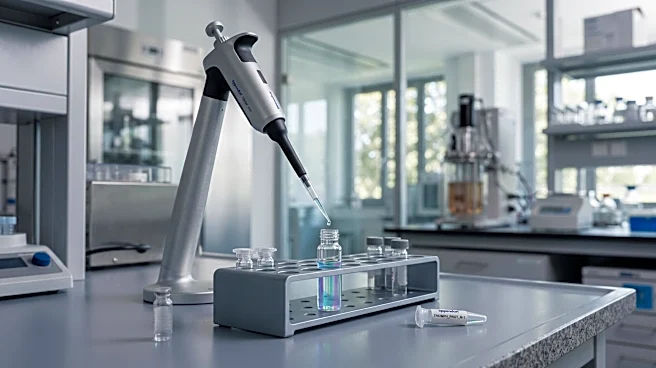
and enhance its environments for evaluating and training AI systems, initially focusing on chemistry and biology. The company addresses a critical challenge in AI development for scientific research: the need for vast, high-quality experimental data to train AI models effectively. Leash Biosciences operates an automated laboratory that generates billions of data points by designing and testing millions of molecules against hundreds of protein targets. This unique approach allows AI agents to conduct experiments at computational speeds, providing a continuous stream of real-world scientific data essential for improving AI performance in drug discovery. According to Ian Quigley, CEO and co-founder of Leash Biosciences, their goal is to create a 'school for AI scientists' by generating data specifically for AI curriculum, which differs from traditional data collected for drug discovery.
Why It's Important?
This funding for Leash Biosciences is significant for the U.S. scientific and technology sectors, particularly in drug discovery and artificial intelligence. The ability to rapidly generate and utilize massive biochemical datasets for AI training can dramatically accelerate the pace of scientific breakthroughs. By providing AI models with real experimental outcomes, Leash Biosciences is addressing a fundamental limitation in current AI applications for science, which often rely on data not optimized for model training. This development could lead to more efficient and accurate drug discovery processes, potentially reducing the time and cost associated with bringing new medicines to market. The investment from prominent firms like Insight Partners underscores the growing recognition of AI's transformative potential in life sciences and the critical need for robust data infrastructure to support this evolution. This advancement benefits pharmaceutical companies, AI developers, and ultimately, patients who stand to gain from faster development of new treatments.
What's Next?
With the new $11 million funding, Leash Biosciences plans to expand its operations beyond protein-molecule binding to include additional types of biological experiments. This expansion will broaden the scope of tasks available for AI evaluation and training, fostering new partnerships with AI developers and pharmaceutical companies. The company has already demonstrated the effectiveness of its approach with Minos, a set of virtual research environments, where AI agents completed approximately 100,000 independent sequences of experiments in six weeks. Leash Biosciences also intends to release further results showcasing significant improvements in model performance. These next steps suggest a continued push towards establishing a foundational infrastructure for the next generation of scientific discovery, with potential implications for how research is conducted and how new therapeutic agents are identified and developed.
Beyond the Headlines
The work of Leash Biosciences highlights a deeper shift in scientific methodology, moving towards an integrated approach where automated laboratory experiments and AI model development are intrinsically linked. This synergy could fundamentally alter the landscape of scientific research, making it more data-driven and less reliant on traditional, time-consuming manual experimentation. The ethical implications of AI-driven scientific discovery, particularly in drug development, will become increasingly relevant, focusing on data integrity, model bias, and the validation of AI-generated hypotheses. Furthermore, the development of 'AI scientists' raises questions about the future roles of human researchers and the potential for AI to autonomously drive scientific inquiry. This trend could also lead to a re-evaluation of intellectual property in scientific discoveries, as AI systems become more central to the innovation process.