






What's Happening?
Airbnb CEO Brian Chesky announced the launch of the Airbnb Housing Accelerator, a national initiative designed to address persistent housing affordability challenges across the United States. The program includes an initial $250 million investment for 'last-dollar'
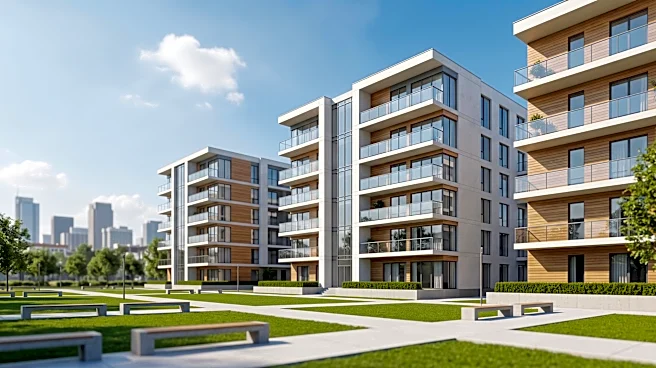
financing for approved housing projects. As part of this initiative, Airbnb is committing $6.4 million to support the redevelopment of the St. John Site in Austin, Texas. This project, a collaboration between the Austin Housing Authority and Greystar, aims to construct over 500 apartments, with more than 200 designated for lower-income tenants, alongside commercial spaces and a new public park. The accelerator also advocates for 'pro-housing' policies, such as zoning and permitting reform, and includes a $5 million housing innovation program to award entities using technology to streamline homebuilding. Austin was chosen for the launch due to its ongoing efforts in affordable housing and development rule reforms, which have reportedly led to a decline in median rental rates.
Why It's Important?
This initiative is significant as it marks a major step by a prominent tech company, Airbnb, into directly funding and advocating for affordable housing development. The housing affordability crisis is a critical issue impacting communities nationwide, affecting economic stability and social equity. By providing 'last-dollar' financing, Airbnb aims to unblock stalled housing projects, potentially accelerating the creation of much-needed affordable units. The focus on policy advocacy, particularly zoning and permitting reform, could influence local and state governments to adopt more housing-friendly regulations, which are often cited as barriers to development. The investment in Austin highlights a model for public-private partnerships in addressing housing shortages, demonstrating how corporate resources can complement municipal efforts to create more accessible living options. This could set a precedent for other companies to engage in similar initiatives, fostering a broader movement towards sustainable urban development and economic inclusivity.
What's Next?
Following the launch, the Airbnb Housing Accelerator will continue to identify and fund housing projects across the U.S., with a particular focus on areas demonstrating a commitment to pro-housing policies. The $6.4 million investment in Austin's St. John Site is expected to facilitate the construction of hundreds of apartments, including units for lower-income tenants, with ground-breaking anticipated in the near future. The program's advocacy for zoning and permitting reform will likely involve ongoing engagement with local governments and urban planning bodies to streamline development processes. The $5 million housing innovation program will begin awarding grants to individuals and entities leveraging technology to improve homebuilding efficiency, potentially leading to new construction methods and cost reductions. Future developments will include the expansion of the 'city index' to rank local housing policies, providing data-driven insights to guide further investments and policy recommendations.
Beyond the Headlines
Airbnb's venture into housing development and advocacy represents a strategic shift for a company traditionally focused on short-term rentals. This move could reshape public perception of Airbnb, positioning it as a contributor to long-term housing solutions rather than solely a factor in housing market dynamics. The initiative also raises broader questions about the role of large corporations in addressing societal challenges typically handled by government or non-profits. By investing in affordable housing, Airbnb is implicitly acknowledging its impact on urban housing markets and attempting to mitigate potential negative externalities. This could lead to increased scrutiny and expectations for other tech giants to engage in similar social responsibility efforts. Furthermore, the emphasis on technology and innovation in homebuilding could spur advancements in construction practices, potentially leading to more efficient, sustainable, and cost-effective housing solutions in the future.