
What's Happening?
Fives AddUp, a manufacturer of Directed Energy Deposition (DED) 3D printing systems, has announced a strategic partnership with French software developer ADAXIS. This collaboration makes ADAXIS’ AdaOne
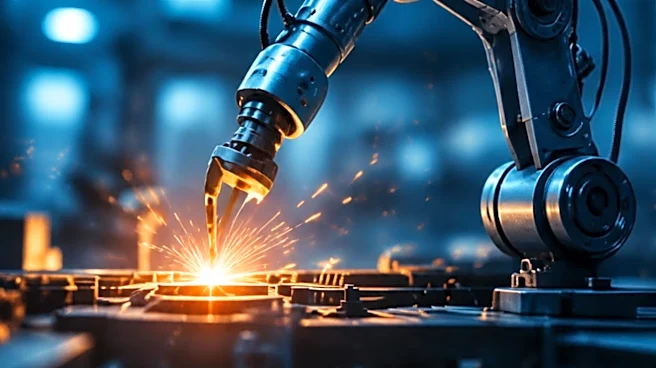
software compatible with Fives AddUp’s BeAM 400 and BeAM 800 DED-LB/P machines. The agreement, unveiled at Formnext 2026, allows users of these machines to prepare jobs, generate complex multi-axis toolpaths, simulate machine motion, and create programs directly within AdaOne. The partnership aims to streamline the implementation of DED technology by more closely integrating software and machinery, thereby making deposition jobs more controlled and repeatable for industrial production. This initiative also provides BeAM users with an expanded choice of programming tools. The development roadmap includes enhancing toolpaths to reflect actual machine behavior, conducting thermal simulations under real manufacturing conditions, utilizing machine parameters and sensor data, and programming functionally graded materials with AddUp’s BeAMix technology. Communication between AdaOne and BeAM equipment will also be strengthened to ensure reliable program transfer and accurate kinematic simulation.
Why It's Important?
This partnership is significant for the U.S. manufacturing sector, particularly in industries that rely on high-value component repair, cladding, and multi-material manufacturing. By making DED technology more accessible and reliable through advanced software integration, U.S. companies can potentially reduce costs associated with replacing expensive parts, improve efficiency in manufacturing processes, and accelerate the adoption of additive manufacturing for complex applications. The ability to generate more precise toolpaths and simulate real-world manufacturing conditions will lead to higher quality parts and reduced material waste, offering a competitive edge to U.S. manufacturers. Furthermore, the focus on an open, flexible software ecosystem could foster greater innovation and collaboration within the U.S. 3D printing industry, allowing for more customized solutions and broader application of DED technology across various sectors, including aerospace and defense, where turbine blade repair is critical. This development could also influence workforce training, requiring new skills in advanced additive manufacturing software and operations.
What's Next?
The partnership's immediate next steps involve further development along four key lines: creating toolpaths that accurately reflect machine and process behavior, implementing thermal simulation for real manufacturing conditions, integrating machine parameters and sensor data, and enabling the programming of functionally graded materials using AddUp’s BeAMix technology. Fives AddUp plans to utilize AdaOne in its own application development at its Laser Technical Center to support the creation and validation of new laser applications. The companies anticipate that these advancements will shorten toolpath development times, improve repeatability, and expand the economic viability of DED applications. Target uses include repairing high-value components, cladding, adding features to existing parts, and multi-material manufacturing. The broader trend of hardware manufacturers opening their machines to specialist software suggests that more such collaborations are likely, potentially leading to a more integrated and efficient additive manufacturing ecosystem.
Beyond the Headlines
This collaboration between Fives AddUp and ADAXIS represents a deeper shift towards intelligent manufacturing and the industrialization of additive manufacturing. The emphasis on controlling what happens during deposition, rather than just generating toolpaths, highlights a move towards predictive manufacturing where processes are optimized for precision and repeatability. This could have profound implications for supply chain resilience in the U.S., enabling localized production of complex parts and reducing reliance on international suppliers. Ethically, the ability to repair high-value components rather than replacing them promotes sustainability by extending product lifecycles and reducing waste. Legally, as DED technology becomes more sophisticated and integrated, there may be a need for updated regulatory frameworks to ensure quality control and safety standards for additively manufactured parts, especially in critical applications. Culturally, this advancement could further cement the role of 3D printing as a mainstream manufacturing method, driving innovation and attracting new talent to the field.