





What's Happening?
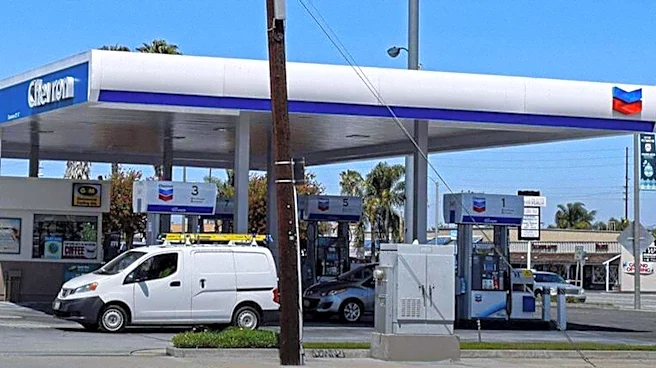
Chevron, a major integrated energy company, recently reported adjusted earnings of approximately $5.28 per share for its latest quarter. This represents a significant year-over-year increase, primarily fueled by a record refining profit of about $4.9
billion, attributed to robust refined-product margins. The company's operating cash flow reached approximately $16 billion, which supported its dividend payments and share buybacks, while also allowing for a reduction in net debt. Despite these strong financial results, Chevron's stock has seen a modest easing from its 52-week high. This is partly due to an anticipated after-tax charge of $3 billion to $4 billion related to its Hess Midstream transaction, and a decrease in the crude war-risk premium.
Why It's Important?
Chevron's strong performance, particularly in its refining segment, highlights the current profitability within the energy sector, benefiting from favorable market conditions and refined-product margins. The substantial operating cash flow demonstrates the company's financial health and its ability to return capital to shareholders through dividends and buybacks, which is attractive to long-term investors. However, the impending charge from the Hess Midstream transaction introduces a near-term financial impact that could affect investor sentiment and the company's immediate profitability outlook. The easing of the crude war-risk premium also indicates a shift in global oil market dynamics, potentially signaling reduced volatility but also impacting the premium associated with oil prices.
What's Next?
Analysts are raising price targets for Chevron, reflecting confidence in its cash-return narrative bolstered by refining strength and cost discipline. However, the market will closely monitor the impact of the $3 billion to $4 billion after-tax charge from the Hess Midstream transaction, which is expected to affect future financial reports. The company's ability to manage this charge while maintaining its strong operational performance will be key. Investors will also be watching for further developments in crude oil prices and refining margins, as these factors will continue to influence Chevron's profitability and stock performance. The balance between solid fundamentals and near-term financial adjustments will shape the company's trajectory.
Beyond the Headlines
The contrasting forces shaping Chevron's sentiment—strong operational results versus a significant one-time charge—underscore the complexities of investing in the energy sector. While robust refining profits indicate efficient operations and a favorable market environment, the Hess Midstream charge highlights the financial implications of strategic acquisitions and divestitures. This situation also reflects the broader market's sensitivity to geopolitical factors, as the fading crude war-risk premium suggests a recalibration of risk in energy markets. For the U.S. economy, Chevron's performance can be an indicator of industrial activity and consumer demand for refined products, influencing energy prices and overall economic stability.