






What's Happening?
The global refinery gas market is projected to experience moderate but steady expansion, with demand rising at a compound annual growth rate (CAGR) of approximately 2.1% from 2026 to 2035, according to the latest IndexBox report. This growth is primarily
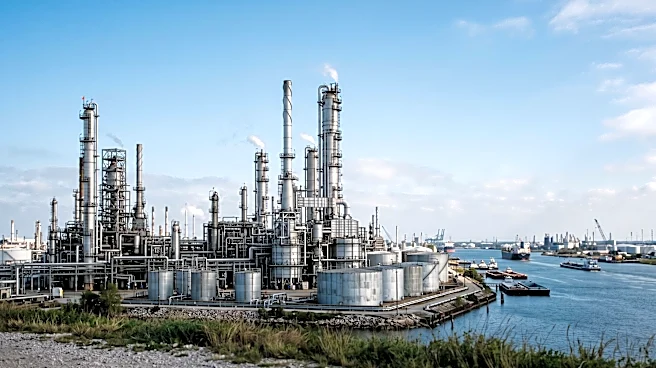
anchored in the projected increase of global refining capacity and crude oil throughput. The market's evolution is characterized by a shift in its center of gravity towards Asia-Pacific and the Middle East, where capacity additions are expected to meet growing domestic demand for fuels and petrochemicals. While mature refining economies in North America and Europe may see flat or declining throughput due to energy transition policies, the petrochemical sector is anticipated to be the most dynamic outlet for refinery gas, driven by rising demand for plastics and synthetic fibers, particularly in developing economies. This trend incentivizes refiners to upgrade gas streams for chemical feedstock use rather than internal combustion.
Why It's Important?
The projected growth in the refinery gas market, particularly its increasing utilization as a petrochemical feedstock, signifies a critical shift in the value chain of the petroleum industry. This development is important for U.S. industries as it highlights the global demand for refined products and their derivatives, influencing investment decisions in refining and petrochemical infrastructure. While North America's share is expected to remain stable due with a mature refining sector and abundant natural gas liquids, the global shift towards Asia-Pacific and the Middle East for capacity additions could impact U.S. competitiveness in certain segments. The emphasis on upgrading gas streams for chemical feedstock use presents opportunities for technological innovation in gas separation and purification, benefiting companies involved in these areas. The market's stability is crucial for refiners like Marathon Petroleum, which is identified as the largest U.S. refiner by capacity, as it ensures a consistent demand for their by-products and contributes to overall profitability.
What's Next?
Looking ahead to 2035, the refinery gas market will continue to be shaped by the interplay of global refining capacity, crude oil throughput, and evolving environmental regulations. Refiners are expected to invest further in technologies that enable higher-value recovery of ethane, propane, and hydrogen-rich streams to meet the growing demand from the petrochemical sector. The push for carbon intensity reduction and circular economy principles will increasingly influence recovery and usage patterns, potentially leading to more sophisticated utilization of refinery gas beyond conventional combustion. While the baseline scenario assumes no major disruptive technological shifts or abrupt policy changes, the long-term trajectory will depend on the pace of energy transition and the adoption of cleaner energy sources. Companies in the U.S. will need to monitor these global shifts to maintain their competitive edge and adapt their strategies accordingly.
Beyond the Headlines
The increasing importance of refinery gas as a petrochemical feedstock has broader implications for the global economy and environmental sustainability. The shift towards integrated refinery-petrochemical complexes aims to maximize the value extracted from every barrel of crude oil, potentially leading to more efficient resource utilization. However, this also raises questions about the long-term environmental impact of increased plastic and synthetic fiber production. The tension between mature refining economies and expanding capacity in growth regions highlights the uneven global distribution of industrial development and its associated environmental footprint. Furthermore, the market faces headwinds from increasing energy efficiency measures and the gradual displacement of refined products in transportation, suggesting a need for continuous innovation and adaptation within the refining industry to remain relevant in a decarbonizing world. The ethical considerations surrounding the production and consumption of petrochemicals will also become more prominent.