


What's Happening?
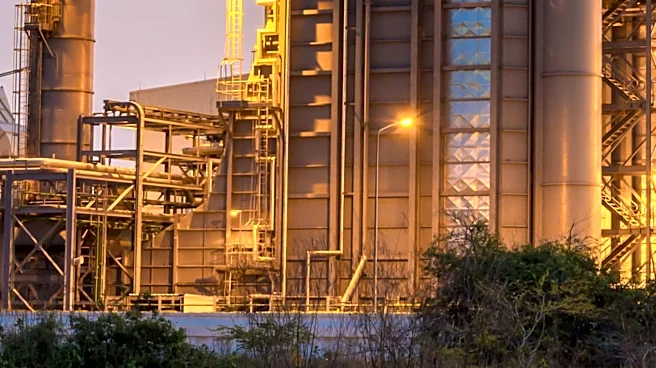
Entergy has submitted plans to the state's Public Service Commission to construct up to 10 new gas-fueled power plants in north Louisiana. These plants are intended to meet the substantial electricity demands of Meta's data center currently under construction
in Richland Parish. The proposed substation for the data center is projected to generate 4,500 megawatts of power, which is approximately four times the peak consumption of New Orleans customers four years ago. This significant power requirement has drawn criticism from groups like the 'Take the Power Back' campaign, who argue that such a large-scale project, particularly one relying on gas-fired plants, will strain the energy grid, impact water supply, and increase air pollution. Entergy, however, asserts that Meta will fully cover the costs of the electrical infrastructure, ensuring that other customers will not subsidize its energy needs. The company also highlights the creation of over 1,500 jobs associated with the construction.
Why It's Important?
The development underscores the escalating energy demands of the artificial intelligence (AI) sector and large-scale data centers, posing significant challenges to existing power grids. Meta's data center in Richland Parish exemplifies this trend, with its projected power consumption far exceeding that of major metropolitan areas. This situation highlights a critical infrastructure bottleneck in the U.S., where the rapid expansion of AI technology outpaces the development of new power generation and transmission capabilities. The reliance on gas-fueled plants for such projects raises environmental concerns and questions about the long-term sustainability of energy sources for the tech industry. The debate also brings to light the economic trade-offs, balancing job creation and investment against potential environmental impacts and the financial burden on ratepayers if the data center's energy needs fluctuate or decrease over time. This scenario could set a precedent for how states manage the energy requirements of future large-scale tech developments.
What's Next?
The Louisiana Public Service Commission will continue to review Entergy's proposal for the new gas-fueled power plants. The 'Take the Power Back' campaign and other environmental groups are expected to maintain their opposition, potentially through further protests and legal challenges, such as the request for intervention by the 19th Judicial District Court in Baton Rouge regarding Meta's job and electricity projections. The outcome of these regulatory and legal processes will determine the feasibility and timeline for the construction of the power plants. Additionally, the long-term agreement between Entergy and Meta, which includes Meta paying for the electrical infrastructure, will be under scrutiny to ensure it protects other ratepayers from potential cost shifts. The broader implications for Louisiana's energy policy and its approach to attracting large tech investments will also be shaped by these ongoing discussions and decisions.
Beyond the Headlines
This situation reveals a deeper tension between technological advancement, economic development, and environmental sustainability. The 'AI race' is creating an unprecedented demand for electricity, pushing companies like Meta to explore unconventional and rapid deployment strategies, such as building data centers in 'tents' powered by off-grid turbines in other states. This approach, while addressing immediate power needs, raises questions about grid stability, energy efficiency, and the environmental footprint of such operations. The reliance on gas-fired plants, despite Meta's commitment to pay for infrastructure, highlights the challenge of transitioning to renewable energy sources at the pace required by the tech industry's growth. This could lead to increased scrutiny of energy policies, prompting states to re-evaluate incentives for data centers and consider more sustainable, long-term energy solutions to support technological expansion without compromising environmental goals or burdening existing communities.