








What's Happening?
KLM Royal Dutch Airlines has initiated a significant restructuring program aimed at enhancing its competitiveness and profitability. This plan includes approximately 1,000 additional job reductions, extensive outsourcing of services, and modifications
to its European fleet. The airline states that these measures are necessary to achieve an additional €1 billion in annual earnings improvement to secure its future and fund investments in aircraft, customer service, and employees. The restructuring is a response to high fuel prices, global instability, and increasing competitive pressure within the aviation industry. Approximately 5,000 positions will be affected by the reorganization, though not all will result in job losses. For instance, 1,250 positions at KLM Catering Services have already been reorganized, and 800 positions in Ground Services will be transferred to external providers. Additionally, 2,000 positions, including 1,500 at the customer contact center Cygnific, will be transferred to Air France-KLM. The 1,000 direct job reductions at KLM itself are expected through productivity improvements.
Why It's Important?
This restructuring is crucial for KLM's long-term viability and its ability to maintain its position as a major international airline. The changes reflect a broader trend in the aviation industry where airlines are adapting to economic pressures and evolving market demands. For the U.S., a strong and competitive international airline network, including KLM's operations, is vital for maintaining global connectivity, facilitating trade, and supporting tourism. The simplification of KLM's fleet, focusing on the Airbus A321neo and Embraer E195-E2, aims to reduce maintenance and operational costs, which could lead to more stable and potentially more affordable air travel options for passengers connecting to and from the U.S. The outsourcing of ground handling and maintenance activities also highlights a shift towards specialized service providers, potentially impacting the global aviation services market. The parent company, Air France-KLM, reported a stronger third-quarter operating profit, indicating that strategic adjustments can yield positive financial results, which could influence other airlines' approaches to similar challenges.
What's Next?
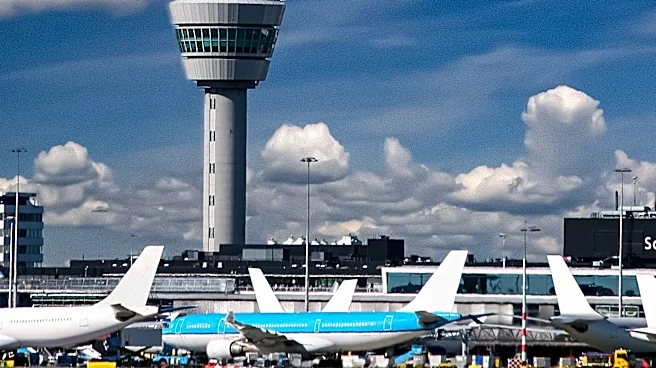
KLM will now engage in discussions with trade unions and employee representatives regarding the proposed changes, including new collective labor agreements. The airline aims for a structural productivity improvement of at least 8% by 2028, alongside moderate wage increases. The phasing out of Boeing 737 and Embraer E190 fleets over the coming years will lead to a more streamlined operation. The proposed expansion involving Scandinavian airline SAS, pending European Commission approval, is expected to create further opportunities for synergies and economies of scale for the Air France-KLM group. This could lead to a more consolidated and efficient European air travel market, potentially affecting route availability and pricing for U.S. travelers. The reorganization of ground handling and maintenance activities will see increased reliance on digitalization and external partners, which will reshape airport operations at Amsterdam Schiphol.
Beyond the Headlines
The restructuring at KLM underscores the ongoing challenges faced by legacy airlines in a dynamic global environment. The emphasis on a 'smaller, simpler, and more flexible organization' reflects a strategic pivot towards agility and cost-efficiency, which could become a blueprint for other airlines. The shift towards greater digitalization in passenger services, allowing travelers to manage check-in and rebooking themselves, points to a future where customer interaction with airlines is increasingly self-service oriented. This could have broader implications for the customer service industry, pushing for more technological integration. The consolidation of cargo-handling activities and the preparation for a new cargo terminal by 2035 indicate a long-term vision for optimizing logistics and supply chains, which are critical for global trade and can indirectly impact U.S. businesses relying on international shipping. The CEO's acknowledgment of the 'painful' changes for employees highlights the human cost of corporate restructuring, a recurring theme in industries undergoing significant transformation.