







What's Happening?
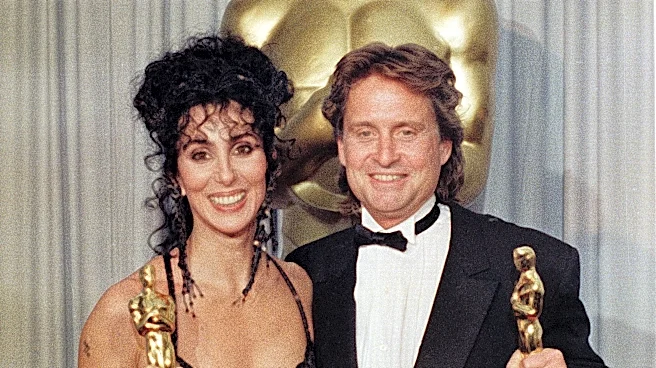
Cher's representative has issued a statement in response to Michael Douglas's recent comments regarding her 1988 Academy Award win for Best Actress in 'Moonstruck.' Douglas, appearing on 'The Graham Norton Show' with Glenn Close, expressed his belief
that Close should have won the Oscar for 'Fatal Attraction' instead of Cher. He noted that Close was on her fourth nomination at the time. Cher's representative stated, 'Cher adores Michael Douglas,' indicating a gracious response to the remarks. At the 60th Academy Awards, Cher won for 'Moonstruck,' while Douglas won Best Actor for 'Wall Street.' 'Moonstruck' secured six nominations and won three Oscars, including Best Adapted Screenplay and Best Supporting Actress. 'Fatal Attraction' also received six nominations but did not win any awards.
Why It's Important?
This interaction highlights the enduring public interest in past Academy Award decisions and the subjective nature of cinematic recognition. For the entertainment industry, such discussions can reignite interest in classic films and performances, potentially leading to renewed viewership or critical re-evaluation. The gracious response from Cher's representative also demonstrates a common approach to managing public commentary among long-standing figures in Hollywood, emphasizing professionalism and mutual respect despite differing opinions. It underscores how celebrity opinions, even decades later, can still generate media attention and engage audiences, reflecting the cultural impact of these awards and the careers they shape.
Beyond the Headlines
The longevity of this discussion, nearly 40 years after the event, speaks to the lasting cultural imprint of the Academy Awards and the films recognized. It also subtly touches upon the competitive dynamics within the acting profession and the often-intense scrutiny surrounding Oscar nominations and wins. The fact that a comment made in a casual interview can still draw a response from another major star's camp illustrates the continuous narrative woven around Hollywood's elite. This kind of retrospective commentary can also influence how younger generations perceive these historical cinematic achievements and the artists involved, shaping their understanding of film history and critical reception.