






What's Happening?
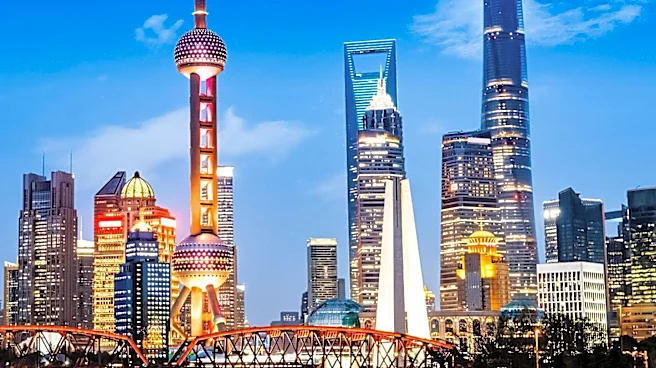
Shanghai's biotech industry is rapidly advancing, with executives claiming faster, cheaper, and more efficient drug development compared to the United States and Europe. This sentiment was highlighted at a recent conference in Shanghai's 'Science City'
district, where leaders from companies like Abbisko, a $6 billion Shanghai-based biotech, showcased their capabilities. Zhui Chen, co-founder of Abbisko, noted that a drug trial licensed to German pharma Merck KGaA was completed in 11 months, prompting Merck executives to seek training from Abbisko. This rapid progress has led to a significant increase in licensing and collaboration deals for Chinese-designed drugs, which now constitute about a third of the world's pipeline. Investment banks like Jefferies are convening conferences in Shanghai to tap into this growing market, with representatives from U.S. venture capital firms and pension funds showing interest, despite existing investment restrictions. The Chinese government has also set ambitious goals, aiming for Chinese drug developers to produce at least five blockbuster drugs and a quarter of all first-in-class drugs by 2030.
Why It's Important?
The ascendance of Shanghai's biotech sector poses a significant challenge to the long-standing dominance of the U.S. in life sciences. This shift could impact the global pharmaceutical landscape, potentially leading to a redistribution of research and development investments and a change in where groundbreaking drug discoveries originate. U.S. pharmaceutical companies and investors are increasingly looking to China for partnerships and opportunities, as evidenced by the interest from a Texas teachers' pension fund and U.S. venture capital firms. Pfizer CEO Albert Bourla has expressed concern, stating that the U.S. could lose its biopharma superiority to China within five years if the focus remains on slowing China down rather than enhancing U.S. innovation. The efficiency and speed of drug development in China, partly due to lower costs and faster patient recruitment for trials, could make it a more attractive hub for bringing new drugs to market, potentially affecting the competitiveness and funding of U.S. biotech firms.
What's Next?
The Chinese government's latest five-year plan for biotech, aiming for five blockbuster drugs and 25% of all first-in-class drugs by 2030, indicates a continued aggressive push in the sector. This will likely lead to further investment and innovation within China, potentially increasing competition for U.S. biotech companies. U.S. investors and pharmaceutical companies will need to decide whether to increase collaboration with Chinese firms, despite geopolitical tensions and investment restrictions, or to redouble efforts in domestic innovation to maintain their competitive edge. The debate between American innovation and Chinese execution will continue, with calls for collaboration rather than pure competition. While the U.S. is still considered a hub for cutting-edge research, the practicalities of bringing drugs to market efficiently and cost-effectively may increasingly draw companies to China, suggesting a potential shift in global drug development strategies.
Beyond the Headlines
The rise of China's biotech industry, particularly in Shanghai, highlights a broader global shift in scientific and economic power. Beyond the immediate commercial implications, this development raises questions about intellectual property rights, ethical considerations in drug development, and the long-term implications for global health equity. The efficiency of Chinese contract research organizations (CROs) and the ability to recruit patients rapidly for trials could set new benchmarks for drug development worldwide. This could also lead to a brain drain from Western countries if scientists are drawn to the faster-paced and potentially better-funded opportunities in China. The emphasis on 'me-better' and novel compounds, moving beyond generics, signifies China's ambition to be a leader in original drug discovery, not just manufacturing. This evolution could reshape the global pharmaceutical supply chain and challenge traditional notions of where scientific leadership resides.