





What's Happening?
California-based company Planted has successfully raised $31.8 million in funding to expand its operations and accelerate the deployment of autonomous solar technology. The capital infusion will support the growth of its robotic fleet and facilitate the launch
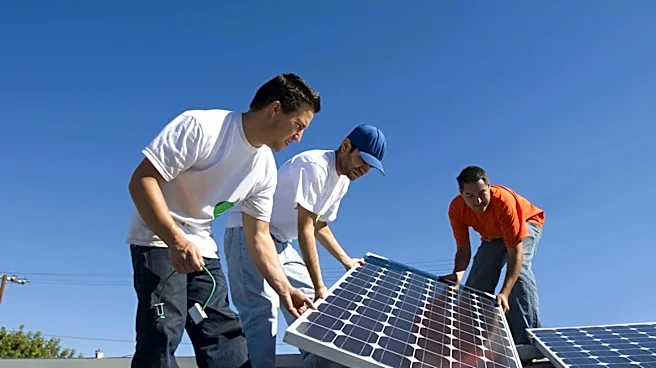
of Sage, the company's next-generation robot. This development comes as demand for solar power deployment significantly outpaces current capacity, with experts projecting a need for five times faster deployment globally by 2050. Planted's approach involves transforming power plant construction into a manufacturing problem, utilizing planning software, high-density terrain-following solar arrays, storage, and field robotics to build on land parcels typically unsuitable for legacy trackers. The company claims its system delivers twice the energy per acre, reducing project footprints and visual impact. Planted has already demonstrated its model with projects like the 28-MW behind-the-meter facility for a neocloud data center, completed in 10 months, and the 11-MW Bowes Solar project in Illinois. The funding round was led by Piva Capital and RA Capital Management Planetary Health, with participation from Breakthrough Energy Ventures, Gigascale Capital, Google, and Khosla Ventures.
Why It's Important?
This significant investment in Planted's autonomous solar deployment technology is crucial for the U.S. energy sector and its broader economic landscape. The ability to deploy solar power five times faster than current rates addresses a critical bottleneck in meeting future energy demands and climate goals. By leveraging robotics and advanced software, Planted can overcome challenges related to supply chains, land availability, interconnection, and skilled labor shortages that currently hinder solar expansion. This innovation could lead to a more efficient and cost-effective method of generating renewable energy, potentially lowering electricity costs for consumers and businesses. The increased speed of deployment also supports the rapid growth of energy-intensive sectors like data centers, which require substantial and reliable power sources. Furthermore, the development of next-generation robots like Sage signifies a leap forward in automation within the renewable energy industry, creating new job opportunities in technology development, manufacturing, and maintenance, while potentially shifting labor demands from traditional construction roles. The involvement of major investment firms and tech giants like Google underscores the perceived value and potential impact of this technology on the future of energy infrastructure.
What's Next?
Planted plans to deploy its next-generation robot, Sage, later this year, which is expected to further enhance its autonomous solar deployment capabilities. The company is on track to increase its deployed capacity from over 10 MW in 2025 to 100 MW in 2026, representing a tenfold increase, with a project pipeline exceeding 20 GW. This rapid scaling indicates a significant expansion of its operations across the U.S. and potentially globally. The success of Planted's model could encourage further investment and innovation in autonomous construction technologies within the renewable energy sector. Stakeholders, including energy developers, investors, and policymakers, will likely monitor Planted's progress closely as it aims to prove the scalability and efficiency of its robotic systems. The company's ability to secure independent engineering validation and project financing for its projects suggests a growing confidence in its bankable development model. The continued integration of planning software, high-density arrays, storage, and field robotics will likely set new industry standards for solar power plant construction, influencing how future large-scale renewable energy projects are conceived and executed.
Beyond the Headlines
The advancement of autonomous solar deployment technology, as exemplified by Planted, carries profound implications beyond immediate energy production. Ethically, the increased automation in construction raises questions about the future of human labor in the renewable energy sector. While it may create new high-skilled jobs in robotics and software development, it could also displace traditional construction workers. This necessitates proactive strategies for workforce retraining and adaptation. Environmentally, the ability to deploy solar arrays on previously unusable land parcels and achieve higher energy density per acre could significantly reduce the land footprint of solar farms, mitigating concerns about habitat disruption and land use conflicts. Culturally, the shift towards highly automated, manufacturing-like processes for power generation could alter public perception of energy infrastructure, moving it from large, visible industrial sites to more integrated, less intrusive installations. Legally, the rapid deployment of these technologies may require updates to permitting processes and regulatory frameworks to accommodate the speed and scale of autonomous construction, particularly concerning safety standards for robotic operations. The long-term shift could see a more decentralized and resilient energy grid, less reliant on large, centralized power plants and more on rapidly deployable, localized solar solutions.