




What's Happening?
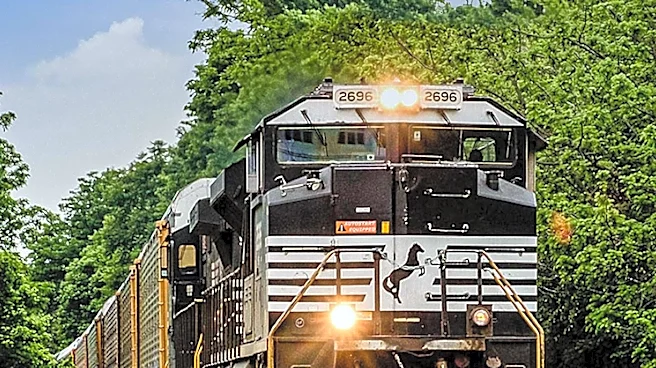
Shane Keller, a retired senior vice president of Operations at Union Pacific Railroad, has voiced his support for a proposed merger between Union Pacific and Norfolk Southern. Keller argues that this combination is fundamentally different from traditional
rail mergers due to minimal network overlap, which would create an end-to-end system. He believes this would reduce interchange friction, improve reliability, and expand transportation options for customers. Keller asserts that modern technology, communications, and operating practices make railroads better equipped to manage complex network integrations than in previous eras. He draws parallels to the Canadian Pacific-Kansas City (CPKC) merger, which he claims eliminated many interchange delays and inefficiencies, resulting in a stronger and more seamless service offering. Keller emphasizes that the key question is whether the merger will create a more efficient transportation network benefiting customers, communities, and the North American economy.
Why It's Important?
This advocacy from a former high-ranking Union Pacific executive is significant because it provides an insider's perspective on the potential benefits of a major rail merger. Such a merger, if approved, would reshape the U.S. freight rail landscape, potentially leading to a more streamlined and efficient national network. The reduction of interchange friction and improved reliability could translate into faster and more predictable delivery times for goods, benefiting businesses across various sectors. This could also lead to cost savings for shippers, which might be passed on to consumers. However, concerns about reduced competition in the industry are often raised with such mergers. Keller's argument that the industry would still feature two major western and two major eastern railroads suggests he believes sufficient competition would remain. The outcome of such a merger would have profound implications for supply chains, economic efficiency, and the competitive dynamics of the U.S. transportation sector.
What's Next?
The proposed Union Pacific-Norfolk Southern merger would likely undergo rigorous scrutiny from regulatory bodies, including the Surface Transportation Board (STB), to assess its impact on competition, service, and the broader public interest. Stakeholders, including other railroads, shippers, and labor unions, would likely present their arguments for or against the merger. The approval process could be lengthy and complex, involving detailed economic analyses and public hearings. If approved, the integration of the two networks would be a massive undertaking, requiring careful planning and execution to ensure a smooth transition and realize the promised efficiencies. The experience of past mergers, such as CPKC, will likely be referenced by both proponents and opponents during this process.
Beyond the Headlines
The debate surrounding major rail mergers like the proposed Union Pacific-Norfolk Southern combination extends beyond immediate operational efficiencies to deeper questions about market concentration and national infrastructure policy. The rail industry has seen significant consolidation over the decades, leading to a highly concentrated market. While proponents argue that larger, integrated networks can offer greater efficiency and investment capacity, critics often raise concerns about potential monopolies, reduced service quality, and increased pricing power. This merger discussion highlights the ongoing tension between fostering competition and achieving economies of scale in critical infrastructure sectors. It also brings to the forefront the role of technology in enabling more complex integrations and the need for regulatory frameworks to adapt to evolving industry structures while safeguarding public interest.