





What's Happening?
Secretary for Financial Services and the Treasury Christopher Hui Ching-yu announced that nearly 290 Beijing enterprises listed in Hong Kong have collectively reached a total market capitalization of HK$13 trillion (approximately $1.66 trillion USD).
These firms have raised a cumulative total of about HK$3.4 trillion (approximately $435 billion USD). Hui shared these figures during the 29th Beijing Hong Kong Economic Cooperation Symposium, emphasizing Hong Kong's role as a leading international financial center and a robust capital platform for mainland enterprises. He also highlighted a significant boom in initial public offering (IPO) funds raised in Hong Kong during the first three quarters, exceeding HK$380 billion, marking a year-on-year surge of over 100 percent. Additionally, the total volume of green and sustainable debt issued in Hong Kong surpassed US$76 billion, with arranged green and sustainable bonds amounting to some US$38 billion, ranking first in the Asian market for eight consecutive years.
Why It's Important?
This substantial market capitalization and fundraising activity underscore Hong Kong's critical role as a financial gateway for mainland Chinese companies, particularly those from Beijing. The significant increase in IPO funds and the robust green finance market demonstrate Hong Kong's continued attractiveness as a listing destination and a hub for sustainable investments. For U.S. and international investors, this indicates a vibrant, albeit complex, market for accessing Chinese enterprises. The 'Going Global' strategy, supported by both Beijing and Hong Kong, aims to assist mainland firms in expanding their global footprint, potentially increasing their presence and competition in international markets. The focus on green finance also signals a growing commitment to environmental, social, and governance (ESG) factors, which could influence global investment trends and corporate practices.
What's Next?
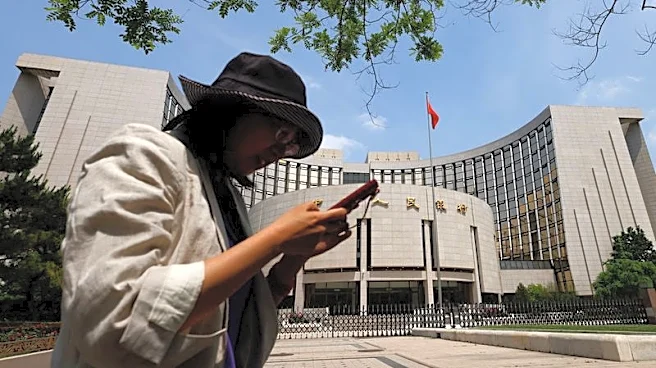
Looking ahead, Hong Kong and Beijing plan to continue their 'Going Global' strategy, with a dedicated task force assisting mainland firms in international expansion. This includes encouraging companies to establish regional corporate treasury centers in Hong Kong through tax concessions and utilizing Hong Kong's established networks for commodities trading. These initiatives aim to enhance global market influence for Chinese enterprises, aligning with China's 15th Five-Year Plan. Secretary Hui also met with officials from the People’s Bank of China to discuss Chinese yuan internationalization, commodities market development, and financial talent grooming, indicating ongoing efforts to strengthen Hong Kong's financial infrastructure and its role in global finance. The continued growth in green finance is also expected, potentially attracting more international capital focused on sustainability.
Beyond the Headlines
The impressive market capitalization of Beijing firms in Hong Kong reflects a strategic alignment between the mainland and the special administrative region, leveraging Hong Kong's international financial infrastructure to support China's economic ambitions. This symbiotic relationship allows Chinese companies to tap into global capital while reinforcing Hong Kong's status as a financial hub. However, the increasing integration also means that Hong Kong's financial markets are more susceptible to economic and regulatory shifts originating from Beijing. The emphasis on green finance and the internationalization of the yuan suggest a broader strategy to reshape global financial flows and standards, potentially challenging existing Western-dominated financial systems. This long-term vision could have profound implications for global trade, investment, and the geopolitical balance of economic power.