
What's Happening?
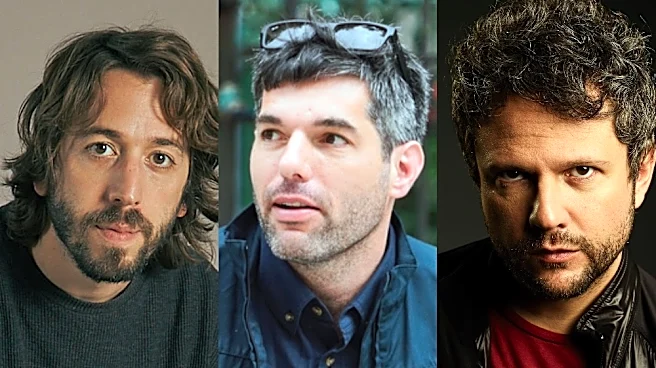
Benjamín Naishtat's film 'The Seven Madmen,' starring Selton Mello and Martin Piroyansky, has concluded its shoot in Buenos Aires. The movie is a contemporary noir thriller loosely based on Argentine novelist
Roberto Arlt’s classic novels 'The Seven Madmen' (1929) and 'The Flamethrowers' (1931). The plot is being kept largely under wraps by producers, but it is described as an intense thriller set in a twisted Buenos Aires. Piroyansky plays Remo Erdosian, a character from Arlt's novel who is threatened with imprisonment for stolen money and seeks help from a mysterious Astrologer, played by Mello, who invites him to join an organization aiming to overthrow the government. Naishtat has spent over a decade working on this adaptation, which he describes as a decidedly free interpretation.
Why It's Important?
This film represents a significant artistic endeavor, bringing a classic piece of Argentine literature to a contemporary audience through the lens of a critically acclaimed director. Benjamín Naishtat is recognized as a major auteur in Latin American cinema, known for combining bold visuals with a concern for contemporary social issues. The adaptation of novels from an era of social fanaticism and the rise of fascism is particularly timely, as Naishtat himself noted, in deciphering the present global and Argentinian context. The project also highlights a collaborative international production effort, involving companies from Argentina, Brazil, France, Spain, and Germany, which is crucial for ambitious Latin American films in the current cinematic landscape. This collaboration underscores the global appeal and potential impact of Naishtat's work and the source material.
What's Next?
With production wrapped, 'The Seven Madmen' will now move into post-production, including editing, sound design, and visual effects. The film is anticipated to be a strong contender for A-List festival selections in 2027, which could significantly boost its international profile and distribution prospects. Following its festival run, the film will likely seek theatrical and streaming distribution deals globally. Audiences and critics will be keen to see how Naishtat's 'free adaptation' reinterprets Arlt's complex themes for a modern era. The success of this film could further solidify Naishtat's reputation and encourage more international co-productions for Latin American cinema, especially those tackling socially relevant themes.
Beyond the Headlines
The decision to adapt Roberto Arlt's novels, written during a period of significant social and political upheaval, speaks to a broader cultural resonance with contemporary global anxieties. Naishtat's intention to 'decipher the Argentinian and planetary present' through these stories suggests a film that will delve into themes of societal unrest, power structures, and individual disillusionment. This adaptation could spark renewed interest in Arlt's literary works and their continued relevance. Furthermore, the film's production amidst what Naishtat describes as 'the darkest moment in Argentine cinema, devastated by a government hostile to any form of cultural expression,' adds a layer of defiance and artistic resilience to the project. It underscores the role of cinema as a medium for social commentary and cultural preservation, even in challenging political environments.