



What's Happening?
Greg Abel, the current CEO of Berkshire Hathaway, has continued the company's strategy of significant share buybacks, spending $9.6 billion on repurchasing its own stock during the third quarter. This move follows the precedent set by his predecessor,
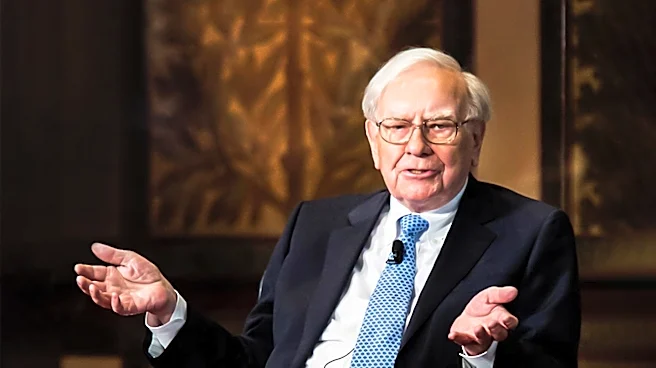
Warren Buffett, under whose leadership Berkshire Hathaway spent approximately $92 billion on buybacks since 2018. Abel assumed the CEO role at the beginning of this year and has been actively managing the conglomerate's capital, making moves that align with the company's established values and culture. The buybacks are seen as a signal of management's confidence in the company's future outlook and a belief that its shares are undervalued. This strategy aims to increase intrinsic value per share by reducing the total number of outstanding shares.
Why It's Important?
The continuation of Berkshire Hathaway's substantial share buyback program under Greg Abel is important for several reasons. Firstly, it signals stability and continuity in the company's capital allocation strategy following a leadership transition, reassuring investors that the core principles established by Warren Buffett remain intact. Secondly, large-scale buybacks can enhance shareholder value by reducing the number of shares, thereby increasing earnings per share and potentially the stock price. This is particularly significant for a conglomerate like Berkshire Hathaway, which is often viewed as a bellwether for broader economic health. The company's confidence in its valuation, as indicated by these buybacks, could influence investor sentiment across the market. Furthermore, in an environment of market uncertainty, Berkshire Hathaway's diversified business model and strategic capital deployment, including buybacks, position it as a potentially stable investment, offering a hedge against volatility.
What's Next?
Berkshire Hathaway is expected to continue its share buyback program as long as management believes the stock is undervalued. The company's approach to capital allocation, including further buybacks and potential acquisitions, will be closely watched by investors seeking insights into its long-term strategy under Greg Abel's leadership. The impact of these buybacks on Berkshire Hathaway's stock performance and overall market valuation will be a key area of focus. Additionally, the company's diversified holdings, including its exposure to technology giants like Alphabet, suggest that its future moves will continue to reflect a balance between traditional value investing and strategic growth opportunities. The ongoing assessment of the company's intrinsic value by both internal management and external analysts will likely guide future capital deployment decisions.
Beyond the Headlines
The sustained emphasis on share buybacks at Berkshire Hathaway under Greg Abel highlights a broader trend in corporate finance where companies increasingly use capital to repurchase their own stock. This practice raises questions about the optimal use of corporate capital, balancing immediate shareholder returns through buybacks against long-term investments in growth, research, and development. While buybacks can boost per-share metrics, critics sometimes argue they can divert funds from more productive uses. However, for a company like Berkshire Hathaway, with its vast cash reserves and a history of disciplined capital allocation, buybacks are often viewed as a strategic tool to return value to shareholders when other investment opportunities do not meet its stringent criteria. This approach reflects a deep-seated belief in the company's intrinsic value and a commitment to maximizing long-term shareholder wealth.