








What's Happening?
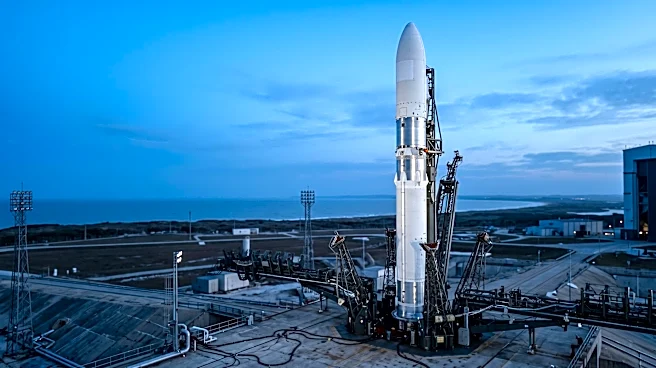
Rocket Lab has announced a further delay for the inaugural flight of its Neutron medium-lift rocket, pushing the launch to 2027. The delay stems from manufacturing problems identified in the carbon composite structures of the rocket's first-stage propellant
tank. Specifically, engineers discovered voids, or air pockets, between the layers of carbon fiber in the dome sections of the propellant tanks. This issue arose after a recent design change intended to strengthen the rocket's structure, which followed an earlier incident in January where a Neutron propellant tank ruptured during a hydrostatic pressure test due to a manufacturing defect at a critical joint. Rocket Lab's CEO, Peter Beck, confirmed that the company is struggling with manufacturing the large booster stage, which is made of carbon composite structures known for their low weight and high strength but are challenging to produce, especially for large components that do not fit into standard autoclaves.
Why It's Important?
This delay for Rocket Lab's Neutron rocket has significant implications for the commercial space launch market, particularly for customers seeking medium-lift launch capacity. With market leader SpaceX pivoting towards its larger Starship rocket and planning to retire its workhorse Falcon 9 from commercial service in the coming years, there is a growing demand for alternative launch solutions for smaller payloads. Rocket Lab's Neutron was positioned to capture a substantial portion of this market. The delay means that satellite operators and other customers will have to wait longer for a viable alternative, potentially impacting their deployment schedules and increasing their reliance on existing, often more expensive, launch options. This setback also highlights the inherent challenges and complexities in developing advanced, reusable rocket technology, even for established players in the space industry. It underscores the technical hurdles involved in scaling up carbon composite manufacturing for large aerospace structures.
What's Next?
Rocket Lab will focus on resolving the manufacturing issues with the carbon composite structures, particularly addressing the voids in the propellant tank domes. This will likely involve further design adjustments, process improvements, and rigorous testing to ensure the structural integrity of the rocket. The company had previously introduced design changes and brought an automated fiber placement machine online to address earlier manufacturing defects, indicating an ongoing commitment to refining its production processes. While the first flight is now slated for 2027, the exact timeline will depend on the successful resolution of these technical challenges. The delay also provides an opportunity for competitors like Relativity Space, Stoke Space, and Firefly Aerospace, who are also developing medium-lift rockets, to potentially gain market share if they can bring their vehicles to market sooner. Rocket Lab will need to manage customer expectations and maintain confidence in its ability to deliver a reliable launch service.
Beyond the Headlines
The challenges faced by Rocket Lab with carbon composite manufacturing reflect a broader industry-wide effort to leverage advanced materials for lighter, stronger, and more efficient spacecraft. While carbon composites offer significant advantages, their production at scale, especially for large and complex structures, presents unique engineering and manufacturing hurdles. This incident underscores the critical importance of material science and manufacturing innovation in the aerospace sector. The push for reusable, rapidly turned-around launch hardware is a defining trend in the space industry, and any delays in achieving this goal can have ripple effects across the entire ecosystem, from satellite development to space exploration missions. The competitive landscape of the commercial space industry is dynamic, and the ability to overcome such technical obstacles efficiently will be crucial for companies like Rocket Lab to maintain their competitive edge and fulfill their long-term strategic objectives.